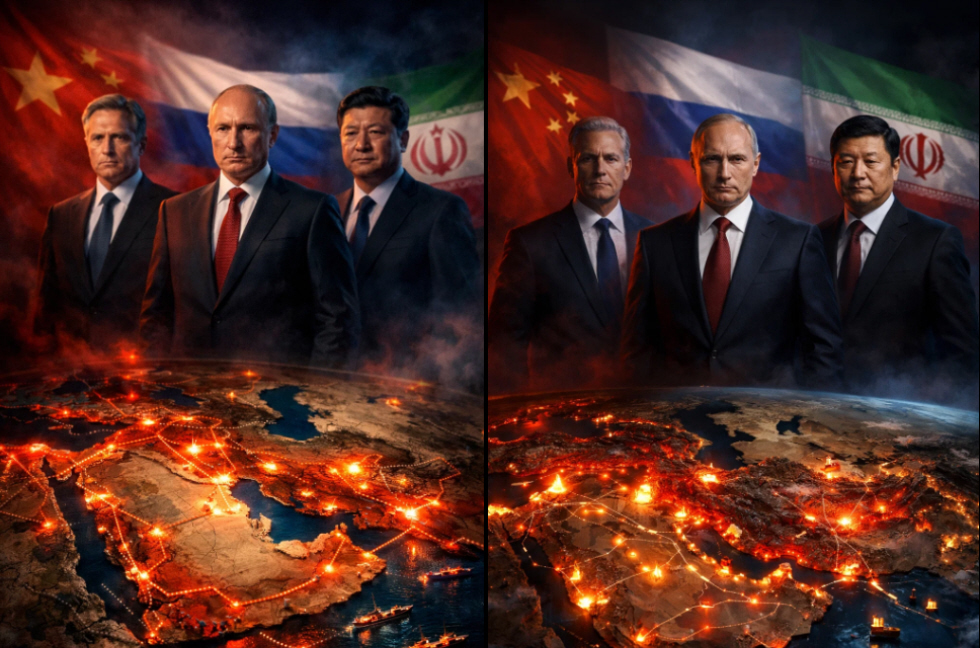
Iran continues to rely on strategic partnerships to sustain its position in an increasingly complex international landscape. Amid rising tensions, support from major powers such as Russia and China has become a central factor. These relationships extend beyond politics, encompassing economic and strategic dimensions. The regional balance is being shaped by these evolving alliances. Moscow has played a significant role in strengthening Tehran across multiple fronts.
Cooperation between the two countries has intensified in sensitive areas, reflecting a convergence of interests in response to external pressures. This relationship is not new, but it has gained greater visibility in the current context. Its impact reaches far beyond bilateral ties. At the same time, China has expanded its involvement in the strategic environment surrounding Iran.
Its approach combines economic interests with active diplomatic engagement. Beijing seeks to maintain stability in regions critical to global trade, particularly those linked to energy flows. However, its role is interpreted in different ways by global observers. Official statements from China emphasize a commitment to peace and stability in the Middle East. The diplomatic message highlights dialogue as the preferred path to resolving tensions. This position aligns with China’s broader international strategy.
Yet, its growing influence in the region continues to raise questions. Some analysts point to a perceived duality in China’s approach, balancing conciliatory rhetoric with strategic interests. This perception fuels debate over the true extent of its involvement. In high-tension environments, every political signal carries multiple interpretations. Ambiguity can be both a tool and a source of risk.
On the global stage, interactions among these powers are reshaping geopolitical dynamics. Alliances are no longer limited to formal agreements but are reflected in practical actions. Indirect support can be as influential as direct involvement. These complex relationships are defining the trajectory of the conflict. Meanwhile, the situation in the region continues to evolve without a clear resolution.
The presence of global actors adds layers of complexity to an already volatile environment. Each development is analyzed in terms of political, military, and economic impact. Stability depends on a web of interconnected factors. In this context, the roles of China and Russia will remain crucial in shaping future outcomes.
Their combination of diplomacy, strategic interests, and global positioning defines their involvement. The challenge lies in balancing influence with stability. The world is closely watching their next moves.