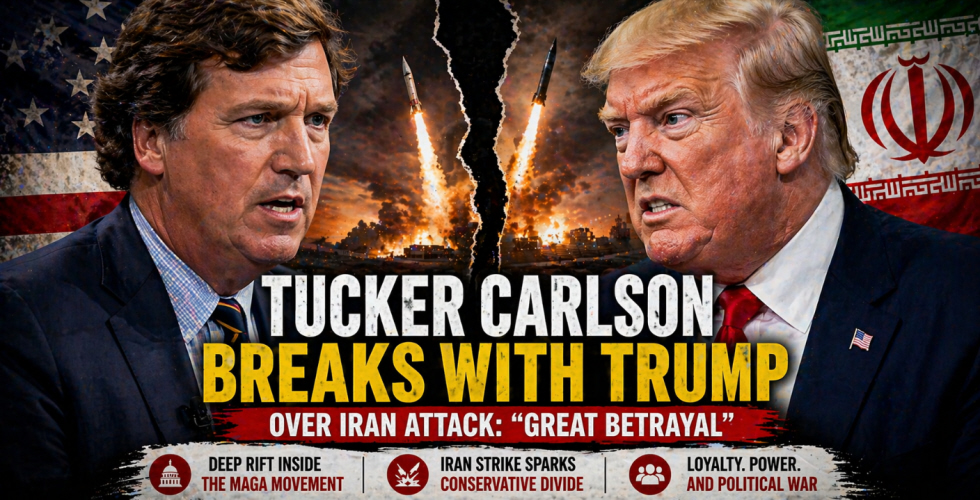
The public break between Tucker Carlson and Donald Trump over the conflict with Iran has shaken one of the most visible pillars of the American conservative movement. What once appeared to be a solid ideological alliance now shows deep fractures, especially around foreign policy and the use of military force. The debate is no longer only about Iran, but about the very identity of Trumpism itself. The discussion strikes at the heart of the MAGA movement. Carlson openly accused Trump of betraying one of the central promises that defined his political rise: avoiding new foreign wars.
For years, the “America First” message was built on criticism of costly and prolonged military interventions in the Middle East. For a significant part of his political base, that rejection was a red line. The possibility of a new confrontation with Iran reopens old political wounds. In his most recent statements, Carlson was especially harsh and described the attack as something “disgusting” and contrary to the principles Trump claimed to defend. He even admitted feeling personally troubled for having helped strengthen that political narrative for years. His criticism was not tactical or superficial, but deeply ideological.
When a figure like that breaks publicly, the impact goes far beyond media headlines. Trump responded with the same force that defines his political style. He said Carlson had “lost his way” and made it clear that he no longer considers him part of the true MAGA movement. The response was not only personal, but also a way of defining who belongs and who remains outside the circle of political loyalty. In Trumpism, loyalty continues to be a central currency of power. The fracture reveals a historic tension within American conservatism: the clash between isolationist nationalism and global military projection.
While some sectors defend an aggressive foreign policy as proof of leadership, others believe that any new war directly contradicts the public mandate to reduce international interventions. Iran becomes the symbol of a much larger dispute. What is being debated is not only a military operation, but a vision of the country itself. There is also an electoral calculation behind this confrontation. In a highly sensitive pre-election environment, any sign of inconsistency within Trump’s message can become a strategic problem.
Carlson represents a voice with enormous influence over conservative voters, especially those most skeptical of the traditional Republican establishment. Losing that support is not a minor issue. Wars are also fought at the ballot box. The reaction inside Republican circles has been mixed. Some leaders support a strong stance against Iran, while others are watching carefully the political cost of opening a new international front.
Conservative unity, so often projected as a solid and disciplined bloc, now shows visible cracks. That division could redefine internal alliances in the coming months. Beyond this specific episode, the confrontation between Trump and Carlson leaves one clear conclusion: the MAGA movement is no longer only fighting against its external opponents, but also within itself.
The question is no longer only who leads the conservative space, but what it truly means to represent that political project. Iran was the trigger, but the conflict runs much deeper. When allies turn against each other, the battle changes dimension.