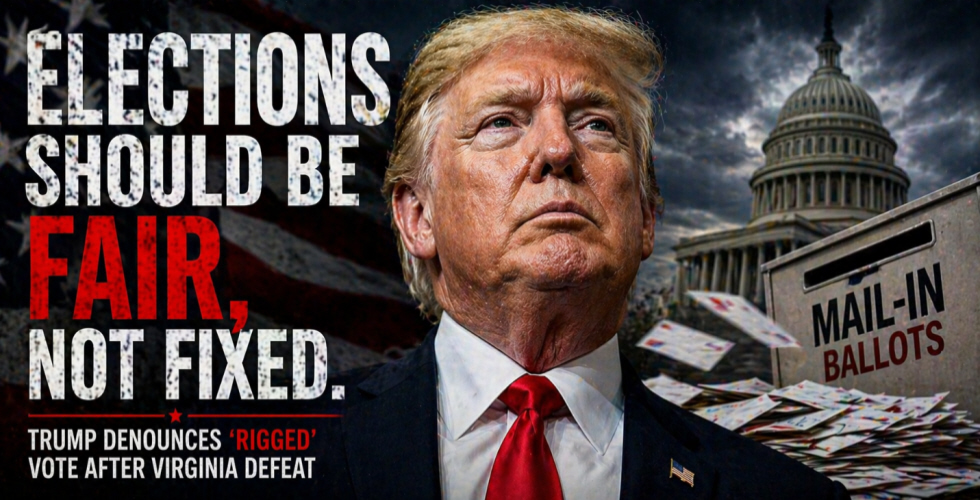
The new reaction from Donald Trump after the Republican defeat in Virginia’s redistricting referendum once again places the issue of election fraud at the center of American political debate. The former president publicly claimed that the vote was “rigged” and pointed especially to a supposed late surge of mail-in ballots during the final hours of the process. His words reactivated a familiar narrative within the national political landscape.
The controversy returned with force. The referendum approved a reform that will allow several electoral districts in Virginia to be redrawn, a change that could directly benefit the Democratic Party with up to four additional seats in the House of Representatives. Although the margin was relatively narrow, the political impact is enormous because it affects the balance of power heading into the next legislative elections. This was not a simple local vote. It was a decision with national consequences.
Trump claimed that Republicans were leading for most of the day and that the atmosphere was clearly favorable until, according to his version, large quantities of mail-in ballots appeared and changed the final result. That accusation was published on his platform Truth Social, where he once again used the language of a “stolen election” that had already defined previous political cycles. The political strategy remains intact. So far, no concrete evidence has been presented to support those accusations.
Electoral authorities have not confirmed structural irregularities or proven fraud in the process. In fact, the most relevant legal debate focuses on the wording of the measure and technical issues related to the certification of the result, not direct vote manipulation. That difference is essential to understanding the conflict. A county judge ordered a temporary pause in certification while reviewing legal questions related to the wording used on the ballot and the constitutional scope of the measure.
That decision was quickly interpreted by some sectors as political validation, although legally it does not represent proof of fraud. In the United States, public perception often moves faster than the courts. Trump’s continued focus on mail-in voting as the center of suspicion reflects a constant line in his political discourse. For years he has presented that mechanism as a potential source of electoral manipulation, even though multiple investigations and court processes have not demonstrated widespread fraud supporting that claim. However, the narrative continues to have strong influence among his voters. Distrust also mobilizes.
For Republicans, the defeat in Virginia is not minor. Losing ground in a key state and facing the possibility of redistricting favorable to Democrats represents a direct threat to future control of Congress. The battle over electoral maps is a battle for real power. Sometimes one district line is worth more than a massive national campaign. Democrats, for their part, defend the measure as a necessary correction to guarantee more balanced representation and to combat historical distortions in voter distribution. From their perspective, the fraud accusation seeks to delegitimize a legitimate result before the new map even takes effect.
The confrontation is not only legal, but deeply narrative. Each party is trying to define reality before the other does. The case shows that in modern American politics, elections do not end when the votes are counted. They continue in courts, social media, newsrooms, and presidential speeches. Electoral legitimacy has become a permanent battleground where every important result can be questioned immediately. Governing also means defending the legitimacy of the result itself.
Beyond Virginia, this new controversy confirms that the issue of fraud will remain a central tool in Trump’s political campaign. What matters is not only the outcome of one specific election, but the ability to keep a political base mobilized that responds strongly to that message. The 2026 electoral battle began long before the ballots are cast. And as often happens, it started with an accusation.