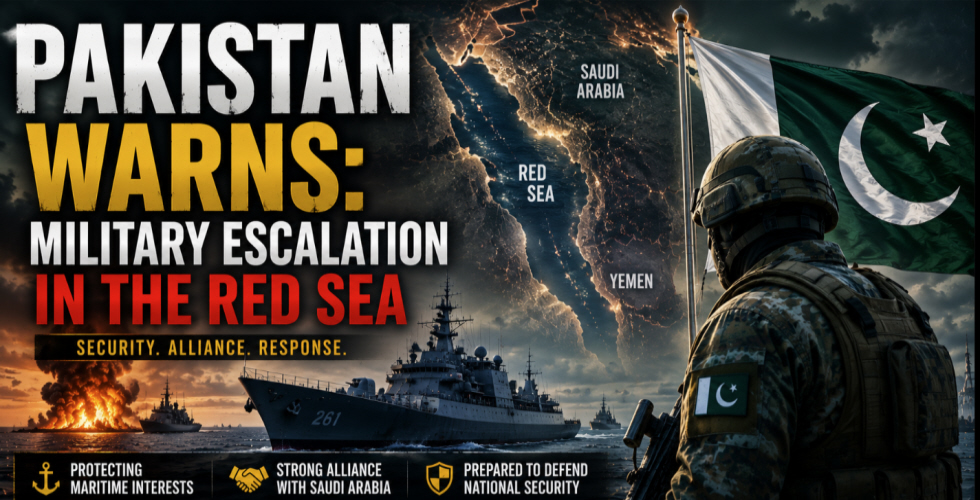
Growing tensions across the Middle East have once again raised international concern after Yemen's Houthi rebels announced new actions targeting Saudi interests in the Red Sea. The development has intensified fears that the conflict could expand beyond its current boundaries and draw additional regional powers into the crisis. In response to the worsening situation, Pakistan declared that it reserves the right to use force if its national interests or the security of its vessels come under threat. The government's position reflects growing concern over stability in one of the world's most critical maritime trade routes.
The Red Sea serves as a vital corridor for the transportation of global commerce, oil, and natural gas. Any major disruption to shipping traffic could affect energy supplies, increase transportation costs, and place additional pressure on the already fragile global economy. Pakistan maintains a close strategic partnership with Saudi Arabia based on decades of political, economic, and military cooperation. That long-standing alliance makes any escalation in the region a matter of direct concern for Islamabad, which continues to monitor developments closely.
Meanwhile, the Houthi movement has intensified its rhetoric against Saudi Arabia following a renewed phase of confrontation linked to a conflict that has lasted for more than a decade. The possibility of additional actions in the Red Sea has placed regional governments and major world powers on heightened alert. Many geopolitical analysts believe the greatest danger lies not only in direct military clashes but also in the possibility that additional nations could become involved if tensions continue to escalate.
Such a scenario could significantly alter the strategic balance throughout the Middle East. Pakistani authorities reiterated that their primary objective is to protect national security and guarantee the safety of their maritime interests. At the same time, officials emphasized that any future actions would depend on how events unfold and on the level of threat facing Pakistani citizens and commercial shipping.
The increase in regional tensions is also keeping international financial markets on alert, as investors closely monitor any incident capable of disrupting global supply chains. The Red Sea remains an essential shipping corridor connecting Asia, Europe, and the Middle East. Diplomatic efforts continue as governments around the world call for restraint and dialogue to prevent a wider military confrontation.
Many international leaders believe avoiding further escalation is essential to preserving regional stability and protecting one of the world's most important commercial waterways. Although the situation remains fluid, recent developments highlight the fragile geopolitical balance in the Middle East. Every new development increases global uncertainty and reinforces the urgent need for diplomatic solutions capable of preserving regional security while safeguarding international trade and maritime navigation.