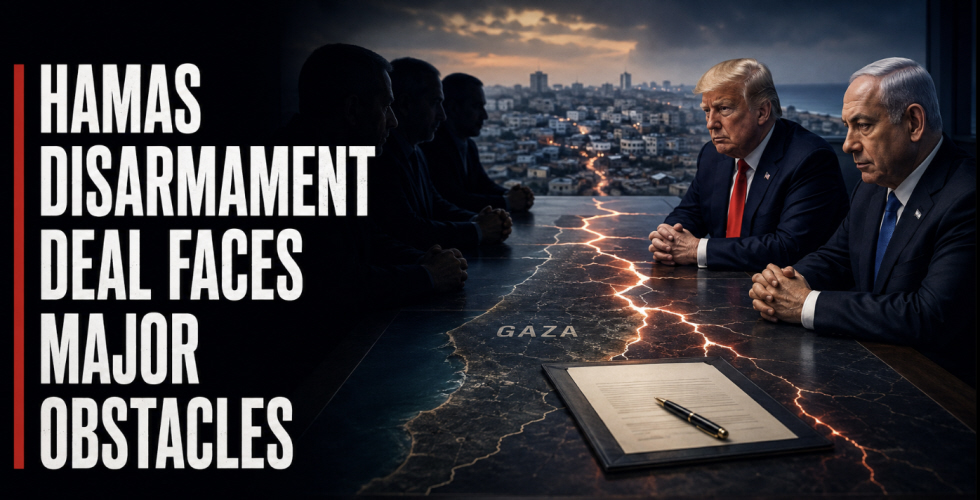
The agreement announced by U.S. President Donald Trump to disarm Hamas has entered a decisive stage marked by deep political disagreements. The initiative, presented as a historic breakthrough, still requires Israel’s approval and effective cooperation. Hamas confirmed its willingness to participate but linked every step to military and territorial conditions. A considerable distance remains between the diplomatic announcement and its actual implementation. The Gaza Board of Peace representative, Nikolay Mladenov, met with Israeli Prime Minister Benjamin Netanyahu on Monday.
During the meeting, he discussed the implementation of the agreement and requested a suspension of Israeli attacks on Gaza. Washington believes that an immediate reduction in violence would allow the disarmament process to begin. Netanyahu has not yet offered public and unconditional support for all the negotiated terms. Hamas maintains that it would begin surrendering its weapons through a gradual and internationally supervised process. However, it is demanding that Israel halt its military operations and progressively withdraw its forces from Gaza.
The organization has also linked the surrender of its heavy weapons to the future creation of a Palestinian state. That condition faces strong opposition within the current Israeli government. The central disagreement concerns the order in which each side would fulfill its commitments. Israel is demanding the complete disarmament of Hamas before carrying out a significant territorial withdrawal. Hamas rejects surrendering its military capabilities while Israeli attacks and troop deployments continue. This contradiction could paralyze the agreement before its practical implementation begins. Continued Israeli strikes over the weekend increased distrust among the parties involved.
New Palestinian casualties were reported while Trump publicly celebrated progress on his proposal. The attacks complicated efforts by mediators to present the agreement as an immediate solution. Conditions on the ground continue to conflict with the optimism expressed in Washington. The disarmament plan would initially involve weapons used by police forces associated with Hamas. A more complicated process involving missiles, explosives, heavy weapons and tunnels would follow. That second phase could continue for several months and require permanent international verification. Any violation could lead to the resumption of major Israeli military operations.
The proposal also seeks to replace Hamas political control with a Palestinian technocratic administration. An international stabilization force would cooperate with a new police service to maintain order during the transition. The United States expects this structure to facilitate reconstruction and reduce the presence of armed organizations. It remains unclear which countries would contribute personnel or which authority would direct those operations. Egypt, Qatar and Turkey continue to serve as important intermediaries between the parties. The three countries have called for an end to the attacks and unrestricted access for humanitarian assistance.
They are also attempting to establish mechanisms for simultaneously verifying disarmament and the Israeli withdrawal. Their ability to retain the confidence of both sides will be decisive during the upcoming negotiations. For Trump, the agreement represents an opportunity to strengthen his reputation as an international negotiator. Failure would damage the credibility of the Board of Peace and expose the limitations of the American strategy.
Netanyahu is also facing pressure from Israeli political factions that reject any concession to Hamas. Internal divisions could influence the outcome as much as negotiations conducted outside Israel. The proposed diplomatic breakthrough must still overcome enormous political, military and territorial obstacles.
A suspension of the attacks would provide the first concrete indication that the parties intend to implement the agreement. Disarmament, withdrawal, security and Gaza’s future administration would then require careful coordination. Until those actions begin, the agreement will remain a fragile promise facing a decisive test.