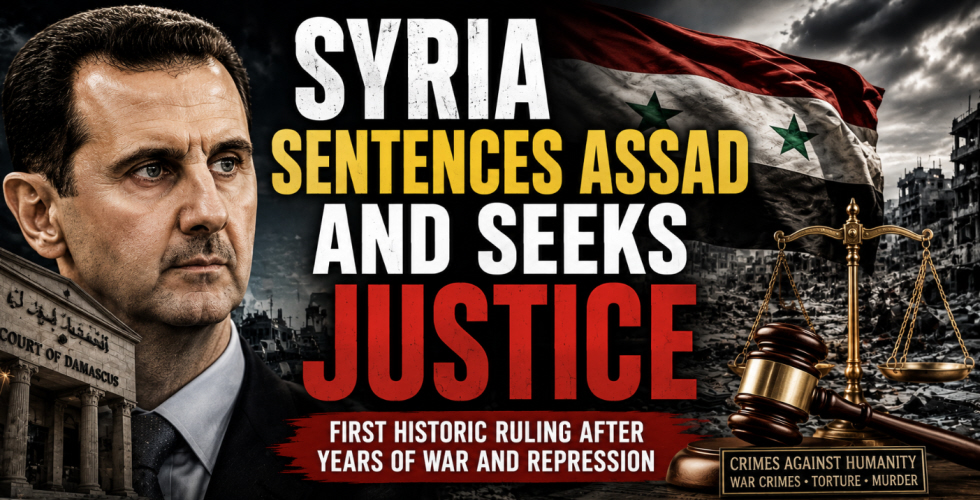
 A court in Damascus has sentenced former Syrian President Bashar al-Assad to death in absentia for killings, torture, arbitrary detention and crimes against humanity connected to the repression that accompanied the beginning of the Syrian civil war in 2011. The ruling represents the first major judicial conviction against Assad since the fall of his government in December 2024. His brother Maher and other former officials from the political and security apparatus also received severe sentences. The ruling opens a new chapter in Syria’s difficult effort to address responsibility for more than a decade of conflict.
Assad ruled Syria from 2000 until a rapid rebel offensive ended more than half a century of his family’s control and forced him to leave the country. During his presidency, protests that began in 2011 developed into a devastating war that destroyed cities, displaced millions of people and left hundreds of thousands dead. Government forces faced years of accusations involving torture, mass detention and severe repression against opponents and civilians. The new ruling now seeks to establish individual responsibility for some of the events that defined that period.
However, the sentence against the former leader currently carries primarily political and symbolic significance because Assad remains beyond the immediate reach of Syrian justice. After leaving Damascus, he found refuge in Russia, a country that for years was one of the principal military and diplomatic supporters of his government. As long as Moscow continues providing him protection, it is extremely difficult to imagine Syrian authorities carrying out the sentence. Assad’s future therefore becomes an issue where justice, diplomacy and international relations inevitably intersect. For Syria’s new leadership, the trial also represents a test of what kind of state it intends to build after decades of authoritarian rule and war.
Punishing crimes committed under the former government may answer legitimate demands from thousands of victims who have waited years for some form of justice. But the transition must demonstrate that courts operate through evidence, transparent procedures and adequate legal protections. A new Syria will struggle to build strong institutions if it replaces the arbitrariness of the past with justice perceived simply as an instrument of the victors. That is precisely one of the major questions surrounding these convictions. Some observers have raised concerns about the speed of the proceedings and whether defendants received sufficient opportunities to defend themselves. Responsibility for serious violations must be investigated and prosecuted, but the legitimacy of a sentence also depends on the credibility of the process used to reach it.
The more serious the accusations and punishment, the greater the requirement for transparency should be. Syria must demonstrate that it is seeking judicial accountability rather than political revenge. The situation presents an even greater challenge because abuses committed during the Syrian war were not attributed exclusively to one side. The former government accumulated extraordinarily serious allegations, but various armed organizations participating in the conflict were also accused of human rights violations. Genuine transitional justice will eventually need to examine responsibility regardless of the political or military position of those accused.
If only the crimes of the defeated government are investigated, part of Syrian society could conclude that the country is practicing selective justice. Russia inevitably occupies a central position in what happens next. Moscow intervened militarily for years to support Assad’s government and later provided him refuge after his fall. Syria’s new authorities must simultaneously determine their future relationship with Russia for diplomatic, economic and strategic reasons. Demanding the former president’s surrender could therefore become considerably more complicated than submitting a simple judicial request.
Assad’s personal fate may ultimately become part of a bilateral relationship involving interests far greater than a single individual. For the families of detainees, missing people and those killed during the conflict, however, geopolitical considerations may be secondary compared with years of suffering and unanswered questions. Many want to know what happened to their relatives, who ordered particular operations and where those who disappeared inside the detention system may be found. A sentence against former leaders can provide important recognition, but it cannot replace the search for truth, documentation and reparations.
Syria’s political reconstruction will also require rebuilding trust between citizens and institutions. Assad’s fall ended a political structure that once appeared capable of remaining in power for decades, but removing a government is considerably faster than building a new state. Syria continues facing enormous economic, social, territorial and political challenges after years of destruction. Transitional justice will be only one part of a process that must also involve reconstruction, reconciliation and protections for the country’s different communities.
The success of the new leadership will depend greatly on demonstrating that Syria’s emerging institutions belong to all Syrians rather than only those who won the war. The death sentence against Bashar al-Assad therefore carries significance extending far beyond the former leader’s personal future. It represents the beginning of a debate over how Syria intends to judge its past while attempting to construct a different political system for the future.
Assad remains protected in Russia and enforcement of the sentence appears distant, but the real test will take place inside Syria itself. Justice can help close the wounds of war only when it is independent, credible and capable of demonstrating that no form of political power stands above the law.