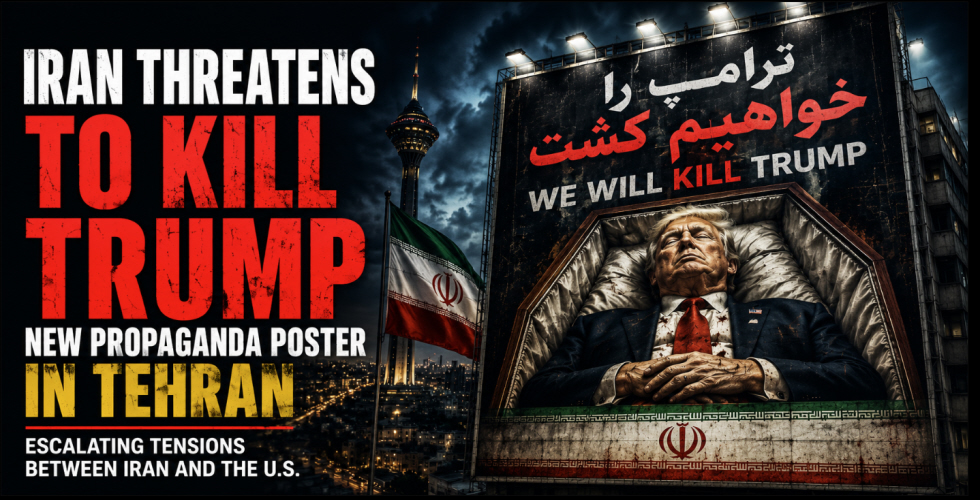
Tensions between Iran and the United States intensified once again after a massive propaganda billboard appeared in Tehran depicting U.S. President Donald Trump inside a coffin. The display, accompanied by threatening slogans in both Persian and English, quickly drew international attention and fueled renewed concerns over the increasingly hostile rhetoric between the two nations. The billboard was installed during a period of heightened political and diplomatic confrontation, reflecting the deep divisions that continue to shape relations between Washington and Tehran.
Positioned in a highly visible location, the display appeared intended to send a strong political message to both domestic audiences and the international community. The imagery highlights the continuing deterioration of relations between Iran and the United States, a rivalry that has long been defined by economic sanctions, military tensions, and sharp political disagreements. The use of such dramatic symbolism demonstrates that the confrontation now extends well beyond diplomacy into the realm of public messaging. Political analysts believe the campaign is designed to reinforce the Iranian government's narrative while projecting an image of defiance toward the United States.
Propaganda continues to serve as a powerful instrument for shaping public opinion and strengthening political positions during periods of international conflict. American officials continue to closely monitor developments involving public threats directed at senior government leaders. Security agencies remain alert as tensions persist across the Middle East and concerns over regional stability continue to influence strategic planning in Washington. The appearance of the billboard has also sparked discussion among international security experts, many of whom warn that increasingly aggressive public messaging can further complicate diplomatic efforts and raise the risk of additional confrontation between the two countries.
Meanwhile, the rivalry between Iran and the United States continues to expand beyond military and political arenas into a broader battle over symbolism and public perception. Images, slogans, and media campaigns have become influential tools used to shape narratives on both sides of the conflict. Photographs of the billboard rapidly spread across international news outlets and social media platforms, transforming the display into one of the most widely discussed geopolitical stories of the day.
The global circulation of the images amplified their political impact far beyond Iran's borders. Experts argue that the incident demonstrates how propaganda remains a significant element of modern geopolitical competition. In today's digital environment, a single image can quickly become a powerful political statement capable of influencing international debate and diplomatic relations.
Although the billboard has not immediately changed the policies of either government, it underscores the fragile state of U.S.-Iran relations and the continuing volatility surrounding their long-standing dispute. Observers around the world will continue monitoring developments closely as both nations navigate one of the most sensitive periods in their relationship.