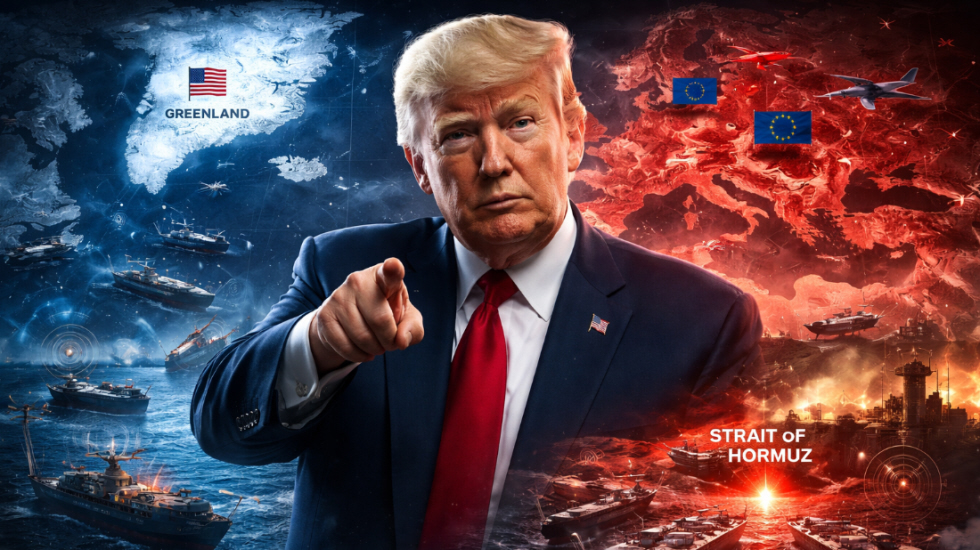
President Donald Trump escalated his geopolitical rhetoric once again by reiterating that the United States should acquire Greenland, amid reports that European nations are drafting a plan to reopen the strategic Strait of Hormuz without U.S. involvement. The statement comes at a time of heightened global energy and military tensions. Speaking on Fox Business with Maria Bartiromo, Trump sharply criticized Europe, accusing it of pursuing exclusionary policies that sideline Washington in key strategic decisions. According to the president, this reflects a lack of recognition for the United States’ longstanding role in global security.
The Strait of Hormuz, through which a significant portion of the world’s oil supply flows, has become a focal point of geopolitical pressure. Any attempt to control or reopen it without coordinated international efforts could significantly disrupt energy markets and strategic alliances. Trump stated that the United States is already taking action to ensure the reopening of the strait, although he did not provide specific details. This claim introduces uncertainty regarding potential military operations or undisclosed parallel agreements. At the same time, his renewed interest in Greenland revives a proposal that previously sparked international controversy.
For Trump, the territory holds strategic value due to its Arctic location and largely untapped natural resources. Europe, meanwhile, appears to be moving toward greater strategic autonomy, particularly in energy and defense matters. Coordinating actions without the United States could signal a major shift in the balance of power within the Western alliance.
Analysts suggest these tensions reflect a growing fragmentation among traditional allies. Competition over energy routes and spheres of influence is reshaping priorities, moving away from historically aligned cooperation models. Trump’s remarks may also serve a domestic political purpose, reinforcing a narrative of strong leadership and defense of U.S. interests against external decisions perceived as unfavorable.
Global markets are watching closely. Any movement involving the Strait of Hormuz has the potential to impact oil prices, global inflation, and broader economic stability. In this context, the combination of Middle East tensions, Arctic ambitions, and transatlantic divisions creates a complex landscape where each decision carries immediate global consequences.