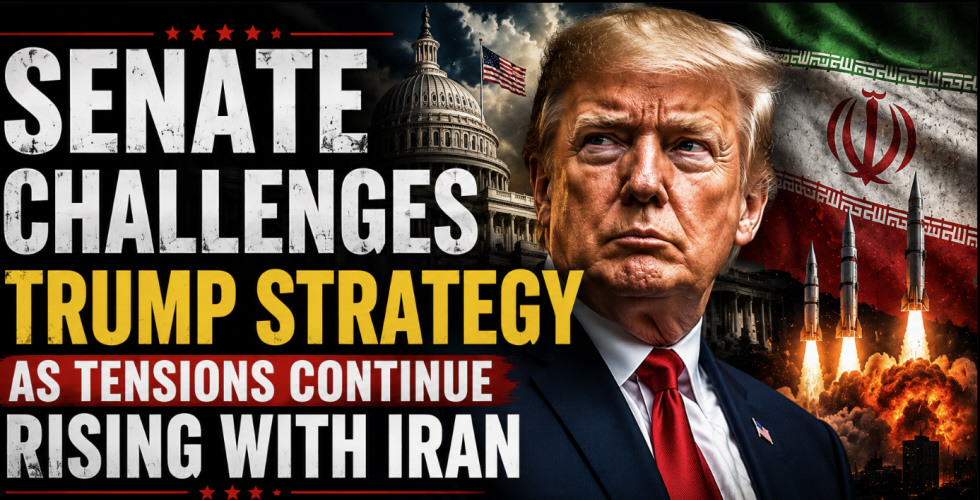
The United States Senate approved a resolution by a vote of 50 to 48, a measure that had previously received support from the House of Representatives earlier in June. Although the resolution is non-binding, its approval has sparked intense political debate in Washington. Many observers view the vote as a sign of growing dissatisfaction within Congress regarding U.S. policy toward Iran. Even some Republican lawmakers have expressed concerns about the direction the conflict has taken.
The outcome reflects an increasingly visible divide between those who support a maximum-pressure strategy and those who believe that further military escalation could have unpredictable consequences for both the region and U.S. interests. The debate comes at a time of heightened international tensions, marked by exchanges of accusations, military movements, and growing concern over the possibility of a broader confrontation in the Middle East. Following the vote, President Donald Trump responded sharply through his Truth Social platform.
The president questioned the timing of the Senate's decision and argued that it could complicate his administration’s efforts. Using a boxing analogy, Trump claimed that Iran was in a position of extreme weakness and that he was close to achieving a decisive victory. According to his remarks, the Senate-approved resolution interferes with a strategy he considers effective. The president argued that the legislative measure sends the wrong signals at a critical moment and makes it more difficult for the United States to maintain pressure and leverage in dealing with the Iranian government.
Despite his criticism, Trump reiterated his confidence in achieving his administration’s objectives. In his message, he insisted that he would continue moving forward with his plans and would find a way to bring the process to the conclusion he envisions. The president’s comments have reignited debate over the role of Congress in foreign policy and national security matters.
Various sectors argue that the legislative branch should exercise stronger oversight whenever there is a risk of deeper military involvement. Meanwhile, the situation continues to evolve, and the differences between the White House and portions of Congress highlight the complexity of the U.S. political landscape as it confronts one of the most sensitive international conflicts of the moment.