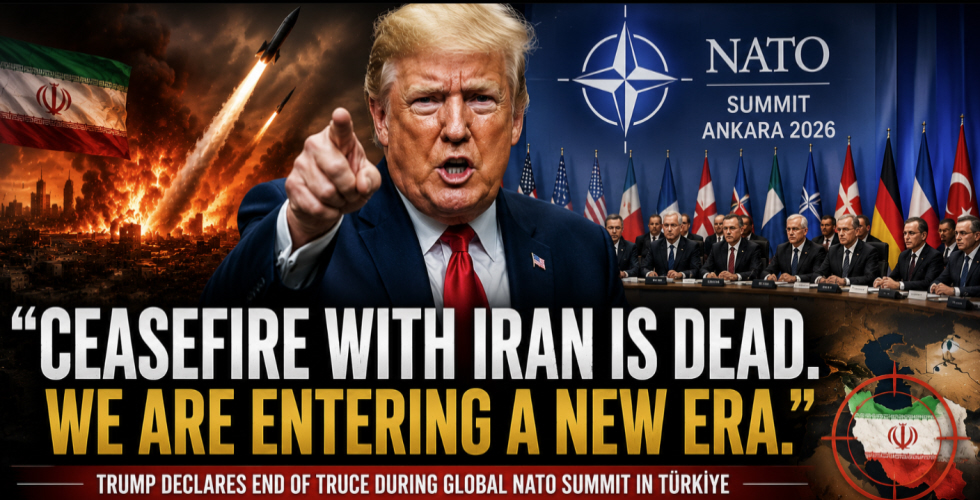
Donald Trump declared the ceasefire with Iran dead during the NATO summit in Ankara. His words marked an explosive turn in a crisis already intensified by recent U.S. military strikes against Iranian targets. The president said that, as far as he was concerned, the agreement was over. The statement immediately raised diplomatic and military tensions across the Middle East. Trump used direct language when speaking about Iran’s leadership. He said dealing with the ruling clerics had become a waste of time. The message was interpreted as a clear break from any immediate path toward negotiation. In the middle of an allied summit, Washington signaled a much harder phase ahead.
The decision came after U.S. forces carried out attacks against positions linked to Iran. The White House described those actions as a response to threats against American and allied interests in the region. Tehran, however, views the strikes as a direct act of aggression. The possibility of a wider escalation is again worrying governments in Europe and the Middle East. The NATO summit was quickly overshadowed by Trump’s announcement. Although the meeting had other issues on its agenda, the Iran crisis moved to the center of attention. European allies reacted with caution and concern.
Many fear that an open confrontation could drag the region into another unpredictable conflict. Trump’s tone was also designed to send a message of strength to allies and rivals. Supporters see the statement as proof of a foreign policy based on maximum pressure and firm responses. Critics argue that it could close diplomatic doors at a dangerous moment. The debate is once again dividing Washington. Iran now faces a difficult choice after the shift in the U.S. position. It could respond with new military action, increase pressure through regional allies, or try to keep some diplomatic channel open. Every move will be closely watched by global powers.
The region is entering another period of dangerous uncertainty. The economic impact could also arrive quickly. A deeper crisis with Iran may affect oil prices and the security of strategic maritime routes. Markets often react nervously when the risk of war rises in the Middle East. For that reason, Trump’s words carry financial weight as well as political importance. In Ankara, NATO leaders will have to measure their next steps carefully.
Some members support a tougher line against Iran, while others want to avoid a military escalation. Allied unity could be tested if the crisis deepens. The challenge will be balancing pressure, security and diplomacy. For Trump, the message appears to be part of a broader strategy. By declaring the ceasefire dead, he is trying to show that the United States will not accept threats or negotiations without results.
But that position also increases the risk of miscalculation. In such a sensitive region, one decision can change the direction of events. In conclusion, the end of the ceasefire with Iran has turned the NATO summit into a moment of high international tension. Trump has made clear that he believes the path of understanding with Tehran is exhausted. Now the question is whether the world is moving toward controlled pressure or a larger military escalation. The answer could define the coming days in the Middle East.