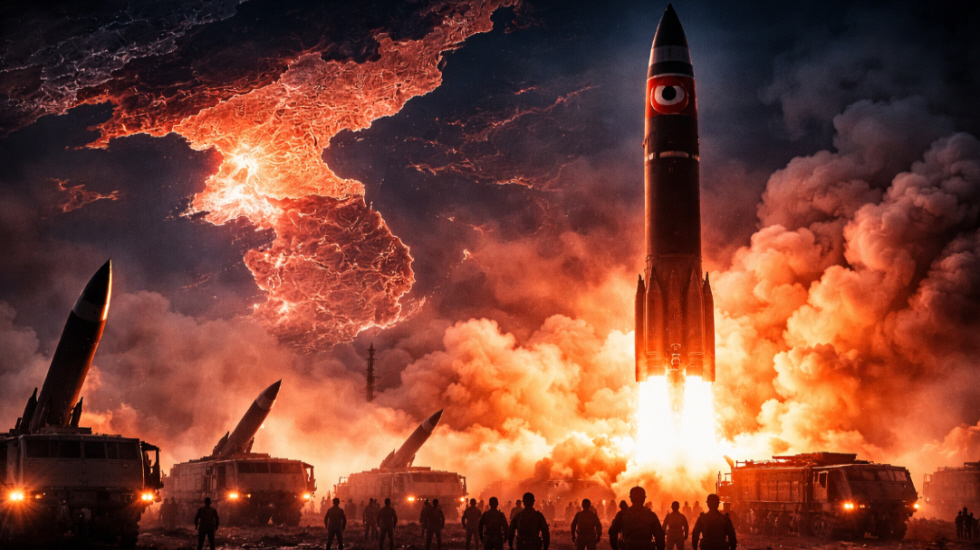
North Korea may be significantly accelerating the expansion of its nuclear capabilities, according to a warning from the International Atomic Energy Agency. The alert reinforces growing global concern over the regime’s military ambitions. This new assessment suggests faster progress than previously expected in recent years. The international community is beginning to evaluate the broader implications. IAEA Director General Rafael Grossi made these remarks during an official visit to Seoul on April 15. From there, he emphasized that North Korea’s nuclear development has reached a level requiring urgent attention.
His comments reflect increasing concern among international institutions. The situation is beginning to escalate diplomatically. North Korea conducted its first nuclear test in 2006, marking the beginning of a sustained military strategy. Since then, the country has advanced both its technological capabilities and its arsenal. Each test has contributed to refining its offensive potential. Progress has been steady and difficult to contain. Current estimates suggest the regime may possess around 50 nuclear warheads. However, Grossi indicated that the actual number could be higher, describing it as “several dozen” operational weapons.
This gap in estimates creates uncertainty among global observers. The lack of transparency complicates any precise assessment. Even more concerning is the pace of recent progress. The IAEA chief warned that North Korea has made “very serious” advances in its ability to produce additional nuclear weapons within a short timeframe. This points to an acceleration in its strategic program. The speed of development increases global risk levels.
These developments are raising tensions across the Asia-Pacific region, where countries such as South Korea and Japan are watching closely. The prospect of sustained nuclear expansion is altering the regional strategic balance. Defensive alliances are beginning to strengthen in response. Regional stability is entering a more fragile phase. The United States and its allies have reaffirmed their commitment to nuclear non-proliferation, yet North Korea continues to challenge diplomatic efforts.
Sanctions and negotiations have not fully halted the program’s progress. This raises questions about the effectiveness of current strategies. International pressure may intensify. In this context, the expansion of North Korea’s nuclear program represents not only a regional threat but a broader global instability factor.
Each new development increases concern over potential conflict scenarios. The global balance could be affected if the situation continues to escalate. International attention remains on high alert.