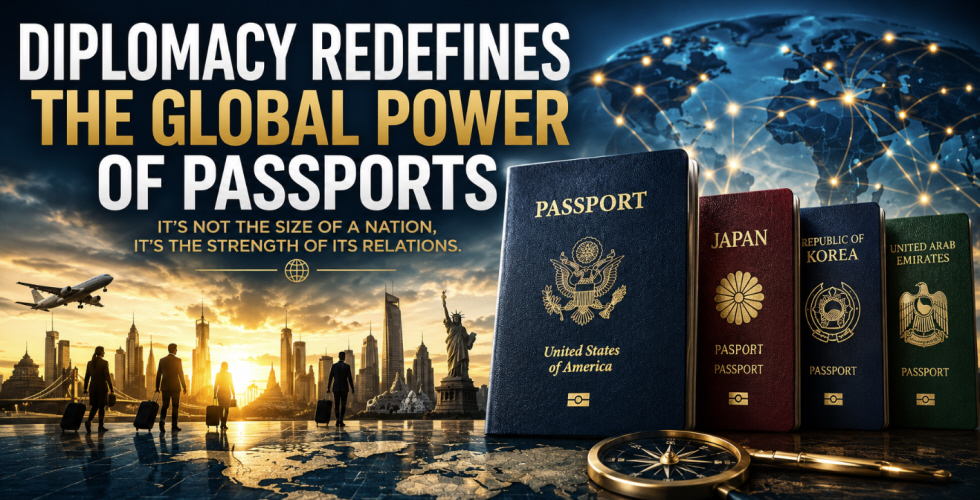
The United States passport remains one of the travel documents offering the greatest international access, although it currently stands in tenth place on the Henley Passport Index. That position may seem surprising considering America’s enormous economic, political and military influence, but the ranking does not attempt to measure any of those characteristics. Its primary purpose is to determine how many destinations a person can visit without obtaining a traditional visa in advance. Therefore, ranking lower does not mean that the American passport is less valid, secure or internationally recognized.
The ranking compares 199 passports and examines entry requirements across 227 destinations around the world. The United States currently provides access without a prior visa to approximately 180 destinations, a figure that still places Americans among the travelers enjoying the greatest international mobility. Singapore leads the ranking, while Japan, South Korea and the United Arab Emirates appear immediately behind it. Differences among the highest-ranking passports can sometimes amount to only a handful of additional destinations offering easier entry. One of the most interesting aspects of the ranking is the remarkable rise of the United Arab Emirates over the past two decades.
The country developed a diplomatic strategy focused on expanding international agreements, strengthening bilateral relationships and securing easier entry conditions for its citizens. The result has been an extraordinary increase in the number of destinations available without obtaining a visa beforehand. Its position demonstrates how diplomacy can become an effective tool for directly increasing the international mobility of a country’s citizens. The United States maintains extraordinarily broad diplomatic, commercial and strategic relationships, but it also applies relatively strict immigration and security policies to certain foreign visitors.
That reality can influence the principle of reciprocity used by some governments when establishing their own entry requirements. A country may decide to offer easier access to citizens of another nation when its own citizens receive similar treatment in return. When that reciprocity does not exist, negotiating additional visa-waiver agreements can become considerably more difficult. Diplomatic relationships therefore play an indirect but important role in determining the strength of any passport within this type of ranking. Countries maintaining strong relations can negotiate agreements specifically designed to facilitate tourism, business travel and other short-term visits.
Difficult political relationships, by contrast, can result in greater controls, additional requirements or the obligation to obtain a visa before traveling. A passport consequently reflects, to some degree, the international relationships maintained by the country that issues it. North Korea represents an extreme example of how relations between governments can directly affect the mobility of their citizens. Washington and Pyongyang do not maintain normal diplomatic relations, and significant restrictions exist for Americans interested in traveling to North Korean territory.
In that case, there are not only requirements established by North Korea but also limitations imposed by the United States on using an ordinary American passport for such travel. The situation demonstrates that international mobility depends on considerably more than simply possessing a valid passport. For this reason, describing a document as the “world’s most powerful passport” can create a misleading impression unless the meaning of that expression is clearly explained. The index does not determine which citizenship provides greater legal protection, which country has greater global influence or which government offers better consular services.
It also does not compare economies, military forces, political stability or institutional quality. The term power essentially refers to the number of borders that can be crossed without completing a traditional visa process beforehand. The American position should also be considered from a historical perspective because the United States once led this global ranking in 2014. Since then, other countries have significantly expanded their mobility agreements, with some moving more rapidly in negotiating additional visa exemptions. This does not necessarily mean that the United States has lost ten levels of global influence during that period.
It primarily means that other passports have increased the number of destinations available to their citizens without a prior visa at a faster pace. The trend also reveals how international diplomacy is changing in a world where facilitating mobility can become an economic and strategic instrument. Easier travel encourages tourism, investment, business activity and personal connections between different societies. Some governments have deliberately incorporated mobility agreements into their foreign policy and use greater openness as a mechanism for strengthening international relationships.
Global mobility has therefore become another dimension of diplomatic competition among large, medium-sized and smaller nations. The United States’ tenth-place position should therefore be understood as a specific measurement of mobility rather than a general evaluation of the value of its passport or citizenship.
Americans continue to enjoy access to an enormous number of destinations and possess one of the world’s most widely recognized travel documents. Nevertheless, the ranking demonstrates that other countries have managed to expand travel opportunities for their citizens even further through agreements and reciprocal policies. In today’s interconnected world, the power of a passport increasingly depends on how many doors diplomacy can keep open.