
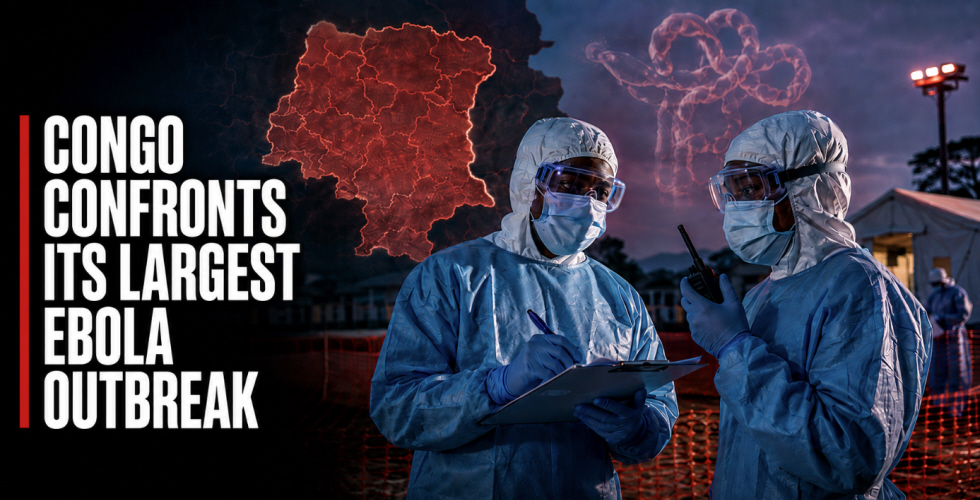
The Democratic Republic of the Congo is facing a serious deterioration in its current Ebola outbreak. The latest figures place the total at 3,748 confirmed cases and 1,657 deaths. The fatality rate remains at approximately 44 percent among laboratory-confirmed infections. By number of cases, it is now the largest Ebola outbreak ever recorded in the country. The emergency was officially declared in May 2026 and represents Congo’s seventeenth Ebola outbreak. Laboratory analysis identified Bundibugyo virus as the strain responsible for the spread. There is currently no approved vaccine or specific antiviral treatment for this variant.
Early medical attention and intensive supportive care can significantly improve a patient’s chances of survival. Ituri remains the main epicenter, although the disease has also reached four other provinces. Confirmed infections have been reported in Haut-Uele, North Kivu, South Kivu and Tshopo. The latest update added 74 new cases, including 49 detected in Ituri. North Kivu reported another 22 infections, while Haut-Uele recorded three. Approximately 690 patients remain hospitalized or in isolation while receiving medical treatment. This number is placing enormous pressure on facilities that were already operating with limited resources.
Specialized centers require additional personnel, protective equipment, medicines and diagnostic capacity. Every delay in isolating an infected person increases the danger to families and surrounding communities. Identifying the remaining transmission chains continues to be one of the greatest challenges. More than 80 percent of new cases recorded in Ituri have not been connected to previously identified contacts. This proportion suggests that numerous infections are still circulating undetected within local communities. Population displacement and restricted access to conflict-affected areas make contact tracing even more difficult.
Another alarming development is the high number of patients dying outside specialized treatment centers. More than 60 percent of recent deaths are believed to have occurred within affected communities. Contact with bodily fluids can transmit the virus during illness and after an infected person has died. Safe and culturally respectful burials are therefore essential to stopping further infections. Violence in several affected areas is also limiting the work of doctors, nurses and contact tracers.
Some healthcare facilities have faced threats, attacks or interruptions that have reduced their operating capacity. Delayed salaries, supply shortages and insufficient international funding are creating additional pressure. Protecting healthcare workers is indispensable for maintaining an effective epidemiological response. The outbreak is also disrupting essential services that are not directly connected to Ebola. Many families avoid hospitals because they fear infection or distrust public institutions.
Prenatal appointments, childhood vaccinations and routine emergency care can be neglected under these circumstances. The crisis could consequently produce additional health consequences among the most vulnerable communities. Ebola does not spread through the air in the same manner as influenza or COVID-19. Transmission primarily occurs through direct contact with blood, secretions, body tissues or contaminated objects.
The global risk remains low, but the local and regional threat continues to be extremely serious. Surveillance has been strengthened along the borders with Uganda and other neighboring countries. Controlling this emergency will require the rapid expansion of testing, isolation and contact-tracing operations.
Authorities must also guarantee safe burials and rebuild trust among affected communities. Cooperation between government agencies, health organizations and local leaders can interrupt the transmission chains. Without a strong and sustained response, Congo could face an even greater expansion of the outbreak.