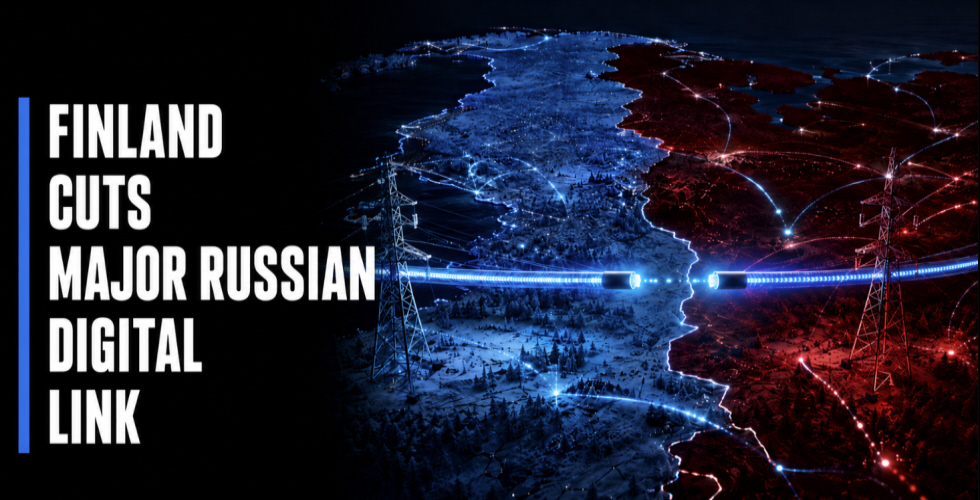
Finland will disconnect a fiber-optic route currently linking its territory with Russia in 2027. The measure represents another reduction in the infrastructure shared between the two countries. The affected connection carries only part of Russia’s international communications traffic. The decision will therefore not cause a complete internet blackout inside Russia. The decision was made by Fingrid, the company responsible for Finland’s national electricity transmission grid. The fiber-optic line had been leased to a telecommunications operator under an agreement that is approaching its expiration.
Fingrid has decided not to renew the contract once the current period ends. The disconnection is expected between the end of 2026 and the beginning of 2027. The telecommunications cables use structures originally constructed to transmit electricity between Finland and Russia. Electricity trading between the two countries ended in 2022 following the deterioration of bilateral relations. Part of the infrastructure has remained active since then solely to support the digital connection. Fingrid considers that maintaining it is no longer justified under current conditions. Russia uses several terrestrial and submarine routes to communicate with international networks.
Finland has nevertheless served as an important corridor for traffic originating in northwestern Russia. Removing this link will eliminate one of the available alternatives for carrying large volumes of data. Russian operators are already examining solutions to replace the capacity that will be lost. Internet users should not be automatically disconnected when the Finnish route stops operating. However, certain foreign services could experience greater latency, temporary congestion or reduced stability. The effect would become more noticeable if other international connections suffered failures or restrictions simultaneously.
Its final magnitude will depend on the alternative capacity that Russia manages to secure. The Finnish measure does not represent a new form of censorship ordered by the Kremlin. Fingrid has not announced a block directed at specific websites, platforms or online content. The company has based its decision on the expiring contract and the future of its physical infrastructure. Even so, the announcement cannot be completely separated from the political confrontation between Russia and Europe. Numerous economic and technical links have progressively disappeared since Russia invaded Ukraine.
Finland ended electricity trading with Russia and strengthened its integration with Western institutions. The future removal of this digital link now extends that process into the telecommunications sector. Every eliminated connection deepens the technological separation between Moscow and its former European partners. Communications infrastructure in the Baltic Sea has also acquired greater importance for regional security. Several electricity and internet cables have suffered damage or disruptions during recent years. These incidents demonstrated the necessity of alternative routes capable of preserving essential services.
The disappearance of one link reduces that redundancy and increases dependence on the remaining corridors. Russian operators could still redirect their traffic through other European countries and routes toward Asia. This reorganization will require new investments, commercial agreements and additional capacity on foreign networks. It could also increase costs for companies that need rapid connections with Western servers.
Moscow may use the transition to strengthen its control over international access points. The decision demonstrates that the internet depends on physical infrastructure affected by contracts, borders and political conflicts.
Towers, cables and network exchanges support a system that is frequently perceived as entirely intangible. Closing a single route will not isolate Russia, but it will weaken another bridge connecting the country with European infrastructure. Finland is therefore opening another stage in the strategic separation transforming the region’s digital map.