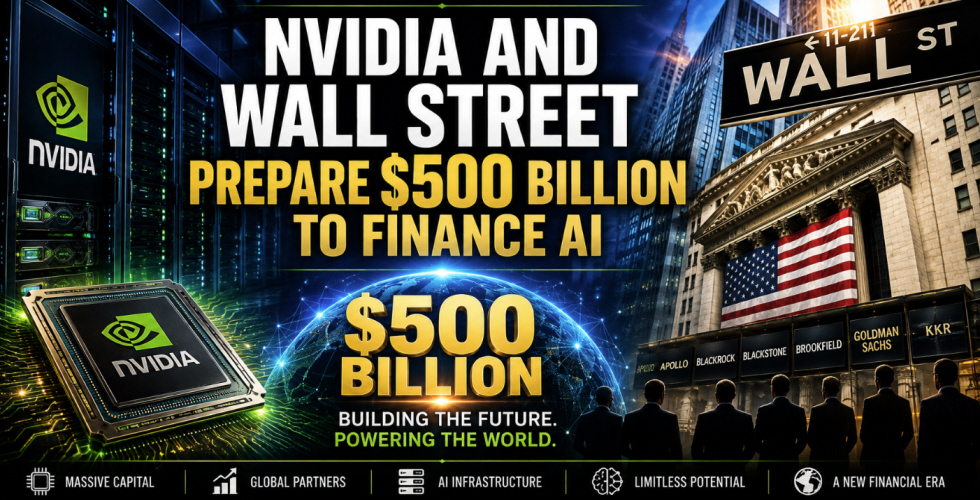
Nvidia is taking the artificial intelligence revolution far beyond semiconductors by joining six financial giants in an initiative designed to mobilize more than $500 billion in outside capital. Apollo, BlackRock, Blackstone, Brookfield, Goldman Sachs and KKR are participating in the development of independent platforms intended to finance artificial intelligence infrastructure. The objective is to provide resources for data centers, computing systems and other facilities required to sustain the extraordinary growth of AI. The scale of the initiative demonstrates that the new technological race is also becoming an enormous financial race.
The operation does not mean that Nvidia will invest $500 billion from its own balance sheet or that the entire amount is already available. The company intends to use the financial capabilities of major institutional investors to progressively mobilize that capital over the coming years. The new platforms would provide competitive financing to companies requiring enormous amounts of computing capacity but unable to immediately assume the full cost of building it. Nvidia would contribute its technological expertise while the financial groups structure different mechanisms to attract private capital into these projects.
The latest developments show that the initiative is already beginning to move from announcements toward actual financial negotiations. Goldman Sachs is holding discussions with U.S. insurers, asset managers, banks and other potential investors interested in participating in the new structures. The bank could provide different forms of financing, including subordinated capital, private credit and debt placements in public and private markets. Participation by major insurers and asset managers could introduce enormous amounts of institutional capital traditionally seeking investments capable of generating income over extended periods.
One of the most innovative elements involves attempting to transform artificial intelligence computing capacity into a genuine financial asset class. Chips, servers and data centers can generate revenue by renting computing capacity to companies, governments, laboratories and AI model developers. If those future cash flows can be reliably estimated, the infrastructure could be used to support loans and other forms of financing. The concept progressively brings computing infrastructure closer to the model that has been used for decades to finance highways, airports, electrical networks and other major infrastructure projects.
Nvidia could participate directly by supporting a portion of certain transactions, but the fundamental intention is precisely to prevent the company from carrying the enormous financial risk of the expansion alone. Under some structures being considered, its support could reach approximately one-quarter of the financing while outside investors would assume the larger portion. That distribution would allow Wall Street’s enormous financial power to multiply the capital available for AI infrastructure. Nvidia would simultaneously retain a strong interest in the projects succeeding because much of the infrastructure is expected to use its processors and technologies.
The strategy therefore creates a particularly interesting economic relationship. Nvidia manufactures many of the accelerators currently dominating the artificial intelligence market and is now helping develop financial mechanisms that could enable customers to deploy enormous quantities of that technology. Greater access to financing could produce more data centers and potentially generate additional demand for specialized processors. The model could dramatically accelerate AI expansion, although it also raises questions about how much technological growth is beginning to depend on increasingly large amounts of debt and institutional capital.
The risks should not be ignored because investments required to build artificial intelligence infrastructure are reaching extraordinary levels. Data centers need expensive processors, specialized buildings, cooling systems, high-speed networks and enormous quantities of electricity. If future demand for AI services fails to produce the revenues currently expected, some projects could struggle to justify investments made under extremely optimistic assumptions. The participation of banks, investment funds and insurers distributes that risk, but it also increasingly connects technological growth directly with global financial markets.
For precisely that reason, Nvidia appears to be seeking structures where outside investors participate after conducting their own evaluations of individual projects. The objective should not simply be providing money to purchase additional chips, but demonstrating that infrastructure can generate sufficient revenue to support the financing used to build it. That financial discipline could become an important test for determining which artificial intelligence projects possess genuine economic potential. The enormous amount announced represents potential financing capacity over several years rather than a single check intended for one company or data center.
The initiative also confirms that global competition in artificial intelligence no longer depends exclusively on who designs the fastest processor or develops the best model. Energy, land, electrical networks, data centers and access to capital are becoming equally strategic elements. Companies capable of raising billions of dollars will be able to rapidly construct enormous facilities, while others could remain limited despite possessing excellent technology.
Wall Street is therefore entering directly into an industrial transformation where financial capital could help determine which companies successfully turn their artificial intelligence ambitions into physical infrastructure. The more than $500 billion Nvidia and its partners intend to mobilize ultimately represents a new stage in the artificial intelligence revolution.
First came the competition to develop better models and processors; now the battle is beginning to finance the digital factories required to operate them on a global scale. Nvidia is positioning itself not only as a chip supplier but as a central component of an ecosystem where technology and enormous pools of capital increasingly work together. The decisive question will be whether this gigantic infrastructure produces enough economic value to justify the extraordinary investments Wall Street is beginning to prepare.