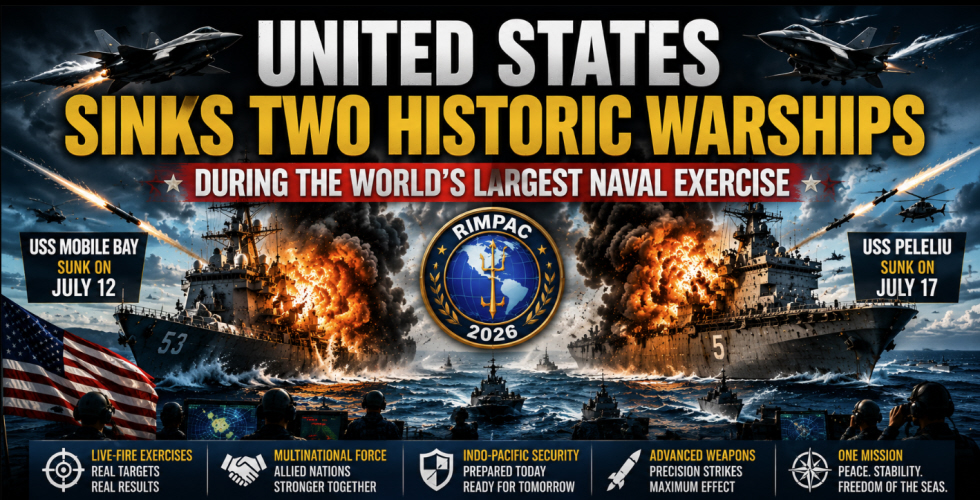
The multinational RIMPAC 2026 exercise once again demonstrated the scale and sophistication of modern naval operations with one of its most remarkable events. During the exercise, two large decommissioned warships were deliberately used as live targets in sinking exercises designed to evaluate combat capabilities. The operation provided valuable data under highly realistic battlefield conditions. The first vessel to be sunk was the guided-missile cruiser USS Mobile Bay, a ship that served for decades as part of the U.S. Navy and participated in numerous international missions.
Its sinking marked the beginning of a series of live-fire exercises intended to test the effectiveness of advanced weapons systems employed by allied naval forces. Several days later, the former amphibious assault ship USS Peleliu met the same fate during a second high-profile operation. The massive vessel had spent years supporting military deployments, humanitarian missions, and strategic operations across the globe. Its final role as a target symbolized the end of a distinguished chapter in U.S. naval history. SINKEX exercises allow participating forces to evaluate precision-guided weapons, coordinated attack tactics, and combat procedures against full-scale naval targets.
Unlike computer simulations, these live exercises provide invaluable operational experience and technical information that cannot be replicated in virtual training environments. The operations were carried out through the coordinated efforts of warships, military aircraft, and multiple defense platforms from several allied nations. This level of integration reflects the growing cooperation among countries participating in RIMPAC, widely recognized as the largest international maritime exercise in the world. After sustaining multiple direct hits, both vessels eventually sank into the deep waters of the Pacific Ocean near Hawaii.
Their remains now rest thousands of meters below the surface, where they will remain after completing their final mission in support of military readiness and operational training. Beyond the dramatic visuals, the primary objective of these exercises is to strengthen the ability of participating forces to respond effectively to increasingly sophisticated naval threats. The lessons learned help improve operational doctrines, combat procedures, and strategic planning for future maritime operations. RIMPAC also highlights the growing strategic importance of the Indo-Pacific region within global defense planning.
The presence of naval forces from numerous nations demonstrates a shared commitment to maintaining maritime security, strengthening alliances, and ensuring stability across one of the world's most critical regions. Military analysts believe that exercises of this magnitude also serve as a powerful demonstration of operational readiness and collective deterrence.
The ability of allied forces to conduct complex, coordinated live-fire operations sends a clear message regarding their capability to protect regional security and preserve freedom of navigation. The sinking of the USS Mobile Bay and USS Peleliu will likely be remembered as one of the defining moments of RIMPAC 2026. More than the retirement of two historic warships, the event symbolizes the continuous evolution of modern naval warfare and the ongoing commitment of allied nations to prepare for the complex security challenges of the future.