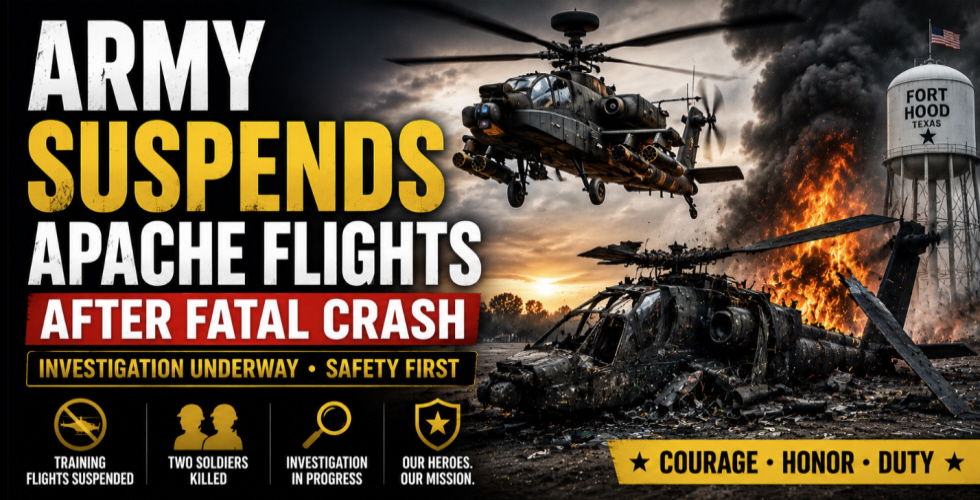
The United States Army ordered a temporary suspension of all AH-64 Apache training flights on Friday following a crash in Texas this week that killed two soldiers. The measure will remain in effect while investigators work to determine what caused the aircraft to go down near Salado, not far from Fort Hood. Military authorities consider it necessary to better understand the circumstances of the accident before normal training operations resume. Apache combat missions are not included in the suspension announced by the Army.
The accident occurred on Wednesday, August 12, when an AH-64E Apache assigned to Fort Hood was conducting a maintenance-related test flight. The aircraft crashed into a field in Central Texas and was subsequently engulfed in flames, also igniting vegetation in the surrounding area. Emergency crews quickly responded to the scene while several nearby homes were evacuated as a precaution. No structures were directly struck by the helicopter during the crash. The two service members aboard the helicopter died as a result of the accident and were identified by the Army on Friday.
They were Chief Warrant Officer 2 Deontre T. Huey, 34, of Killeen, and Warrant Officer Seth L. Olmstead, 25, of Belton. Both were assigned to the 1st Air Cavalry Brigade of the 1st Cavalry Division based at Fort Hood. Huey had entered the Army in 2014, while Olmstead began his military career in 2023. Authorities have not publicly determined what caused the helicopter to crash and have avoided reaching conclusions while the technical investigation gets underway. A specialized team from the Army Combat Readiness Center is participating in efforts to reconstruct the final moments of the flight.
Investigators will examine the wreckage, maintenance information and any available data concerning the operation of the aircraft’s systems. Their objective will be to determine whether a mechanical failure, an operational problem or some combination of circumstances contributed to the crash. The decision to temporarily suspend training flights represents a precautionary measure while investigators search for those answers. The Army considers that continuing certain operations normally before understanding the origin of the accident could create an unnecessary risk for other crews. Such a suspension does not automatically indicate that a widespread defect has been discovered across the Apache fleet.
Its primary purpose is to provide time to identify anything that may require inspection, modification or changes to existing training procedures. The AH-64 Apache has been one of the most important combat aircraft in the U.S. Army for more than four decades. Designed to attack armored vehicles, ground positions and other threats, the helicopter combines heavy weaponry with advanced sensors capable of operating during both day and night. Thousands of Apaches have been operated by the United States and allied countries since the aircraft entered service during the 1980s.
Its importance also explains the attention generated by any accident serious enough to trigger a broad suspension of training operations. Apache combat operations will continue despite the measure announced Friday, establishing a clear distinction between immediate operational requirements and training activities. The Army must maintain certain capabilities while simultaneously protecting crews conducting exercises and preparation inside the United States. That distinction allows necessary missions to continue without ignoring the questions raised by the Texas accident.
The investigation will eventually determine whether additional measures affecting a larger portion of the fleet are required. This is not the first time the U.S. Army has adopted precautionary flight restrictions following serious accidents involving military aviation. When incidents raise concerns about procedures, training or aircraft safety, authorities can temporarily halt certain activities to review existing conditions. Such decisions can affect schedules and readiness, but they also allow risks to be examined before another crew encounters similar circumstances. In military aviation, quickly identifying the cause of an accident can prevent an isolated problem from becoming a recurring threat.
The accident has also had a profound impact within Fort Hood and among the families of the two service members who died. Base authorities have expressed their condolences and said support resources are being provided to relatives, fellow soldiers and members of the affected units. Beyond the value of the aircraft or the operational consequences of the suspension, the loss of two soldiers remains the central human element of the tragedy. The investigation will eventually need to provide answers explaining why a maintenance test flight ended fatally.
The suspension announced Friday transforms the Texas accident into an issue now affecting Apache training operations across the U.S. Army. Investigators must determine whether the crash was an isolated event or whether a problem exists that requires a broader technical response. Until those answers emerge, the Army has chosen to prioritize safety by suspending training flights while maintaining necessary combat operations. Two soldiers lost their lives, and determining exactly what happened will be essential before Apache training crews fully return to the skies.