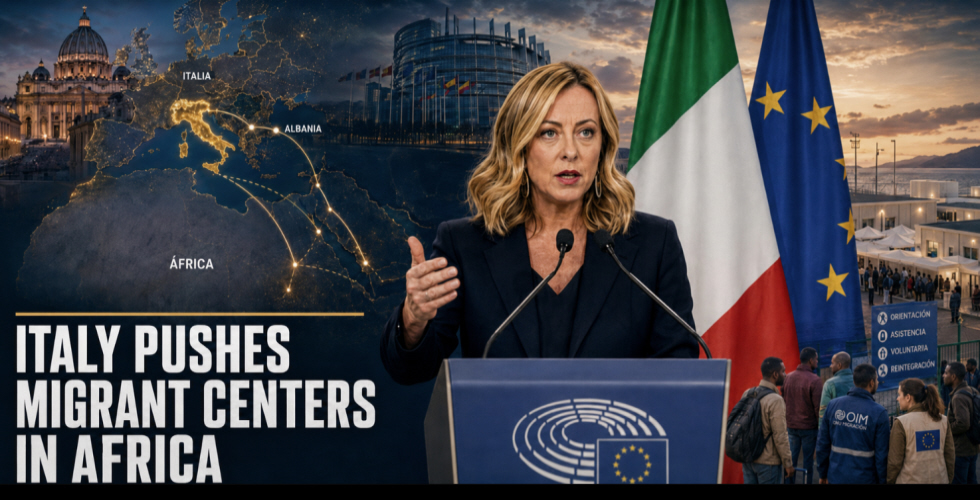
Italy will propose that the European Union create a network of centers to manage and repatriate migrants outside the bloc’s territory. The initiative seeks to expand the so-called Albania model promoted by Giorgia Meloni’s government across Europe. The project will be presented during an extraordinary meeting of European interior ministers. The meeting follows the recent migration crisis in the Spanish enclave of Ceuta. Italian Interior Minister Matteo Piantedosi will defend the proposal before representatives of the member states. Rome considers a common strategy necessary to accelerate the return of people without authorization to remain in Europe.
The centers would operate in countries of origin, transit nations, or other states considered safe. Italy hopes the initiative will gradually become part of European migration policy. The proposal considers establishing centers in several African nations and some countries near Europe. Uganda appears to be one of the most advanced options in the preliminary discussions. Ghana, Senegal, Tunisia, Mauritania, Egypt, Ethiopia, Armenia, Uzbekistan, and Montenegro have also been mentioned. However, no final agreements have been reached with any of those governments.
The facilities would primarily receive irregular migrants facing deportation orders or rejected asylum applications. They would remain there while authorities prepare the documents and procedures required for their return. Supporters argue that this structure would reduce pressure on European migration systems. They also believe it could discourage dangerous journeys organized by human trafficking networks. Italy wants the construction and operation of the new centers financed with European Union resources. Nevertheless, that funding has not yet been authorized by the bloc’s institutions. Member states must negotiate the costs, responsibilities, and supervisory mechanisms.
Financial coverage remains one of the proposal’s main unresolved issues. The Ceuta crisis accelerated the debate concerning the protection of the European Union’s external borders. The mass arrival of migrants from Morocco temporarily overwhelmed the Spanish enclave’s response capacity. The episode produced significant disagreements between Madrid, Rome, and other European governments. Italy argues that the situation demonstrates the need for a much firmer return policy. The Italian government has also criticized the migration strategy pursued by Spanish Prime Minister Pedro Sánchez.
Rome believes some of Madrid’s decisions could convey a message of excessive openness toward irregular migration. Spain, meanwhile, is demanding European solidarity and greater cooperation with Morocco. These differences threaten to transform the migration crisis into another political dispute within the European Union. The model implemented by Italy in Albania has encountered numerous legal, financial, and operational difficulties. The centers constructed there have received far fewer people than initially anticipated.
Several judicial decisions have prevented authorities from validating some detentions and transfers of asylum seekers. Despite those obstacles, Meloni intends to make the facilities fully operational before the end of the year. Humanitarian organizations warn that centers located outside Europe could weaken protections for fundamental rights. They demand access to attorneys, medical care, independent oversight, and transparent asylum procedures.
They also fear the facilities could become places of prolonged detention without sufficient judicial supervision. Italy maintains that any European project must comply with international and European Union law. The proposal will open a complex negotiation over the future of European migration policy.
Some governments support external return centers, while others question their legality, cost, and effectiveness. The final decision will depend on political support, agreements with third countries, and guarantees provided to migrants. The Ceuta crisis has once again placed migration at the center of Europe’s strategic debate.