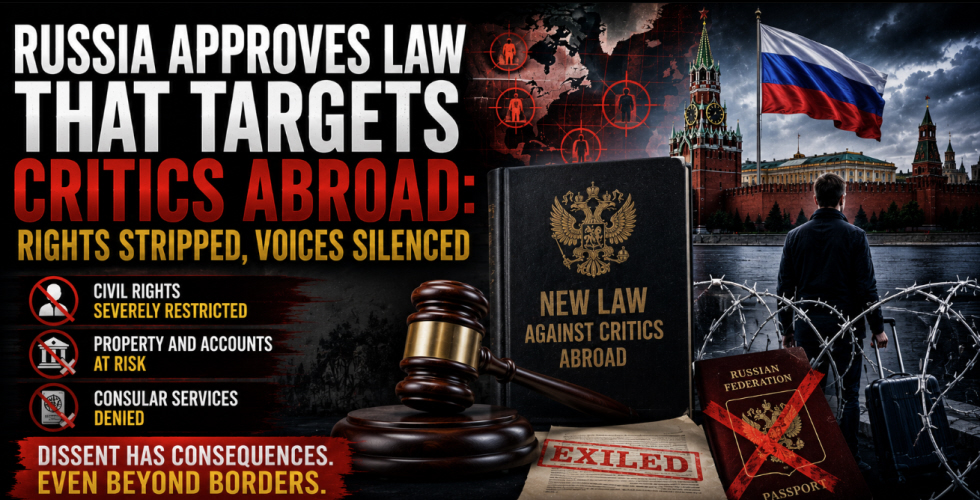
Russia's approval of new legislation affecting certain citizens living abroad has sparked significant political debate both domestically and internationally. The law introduces new restrictions aimed at individuals who openly criticize the Kremlin while residing outside the country. The measure represents another step in Moscow's effort to expand its legal authority over matters considered to involve national interests beyond its borders. International observers are closely monitoring its implementation. According to the new legal framework, the government will have broader authority to apply restrictions to individuals accused of actions viewed as harmful to the Russian state.
Officials argue that the legislation is intended to protect national security and respond to activities they consider damaging to the country's interests. The issue has gained attention as the number of Russian citizens living abroad has continued to grow in recent years. The legislation could affect several administrative and civil rights involving individuals who fall under its provisions. Legal experts believe the new rules may influence matters related to documentation, government services, and other official procedures connected to Russian citizenship.
The practical impact of these measures will become clearer as authorities begin applying the new regulations. Public attention intensified after former Russian State Duma deputy Sergei Petrov, who now resides in Austria, publicly called for even stronger measures against certain former political figures. His statements introduced additional controversy into an already sensitive political discussion. Although his comments do not form part of the newly approved legislation, they have generated considerable public interest. Among Petrov's proposals are possible property confiscations and additional financial penalties targeting former officials connected to the Russian political establishment. These suggestions reflect his personal political position rather than official government policy.
Nevertheless, they have contributed to expanding public discussion about how far future measures could eventually go. The debate continues to evolve both inside and outside Russia. Many political analysts believe the legislation reflects Moscow's increasingly firm domestic policies during a period of heightened geopolitical tensions. Ongoing disagreements with several Western governments and continuing international disputes have influenced many recent political decisions. Each new legislative initiative is now viewed within the broader context of Russia's current strategic posture.
Supporters of the law argue that governments have a responsibility to protect national institutions from coordinated campaigns they believe threaten state security and public stability. From their perspective, the legislation strengthens Russia's ability to respond to activities originating beyond its borders that officials consider harmful to national interests. They maintain that safeguarding state institutions remains a top priority. Critics, however, argue that the legislation could raise new concerns regarding civil liberties and the rights of Russian citizens residing abroad.
They believe the law may expand government authority over individuals living outside the country while increasing uncertainty about future legal protections. Human rights organizations are expected to continue monitoring its application closely. The legislation may also influence Russia's diplomatic relations with several European countries where large Russian communities currently reside.
Future political and legal developments could shape how foreign governments respond to the implementation of these new provisions. Diplomatic discussions surrounding the issue are likely to continue in the coming months. The approval of this legislation demonstrates Russia's determination to reinforce its authority over matters it considers essential to national security, even when they involve citizens living overseas.
As implementation begins, both supporters and critics will closely examine its legal consequences and political impact. The issue is expected to remain an important topic within the broader international discussion surrounding Russia's domestic and foreign policy.