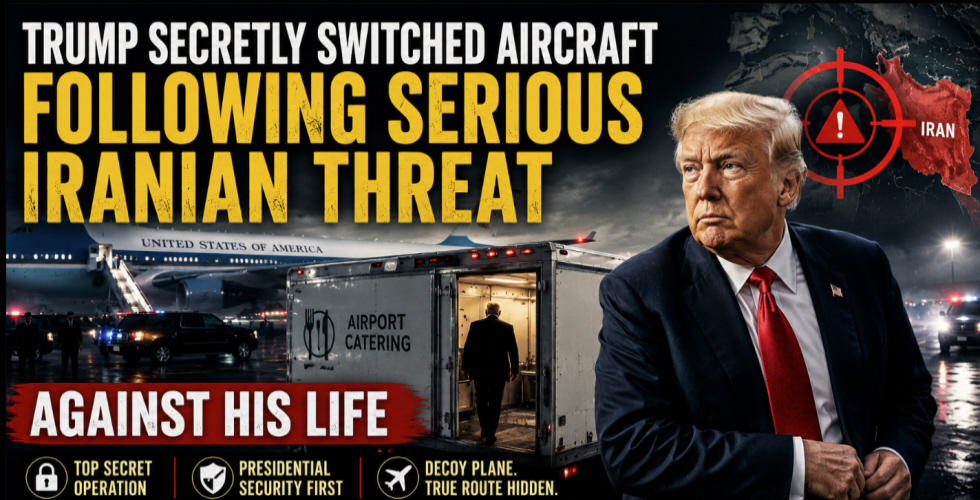
An extraordinary security operation was reportedly organized to protect U.S. President Donald Trump after American authorities received information about a possible Iranian threat against his life. The episode occurred following the NATO summit held in Ankara in July and forced officials to discreetly modify the president’s travel arrangements. Trump ultimately left Turkey aboard a different aircraft from the one he publicly appeared to be using. The operation remained concealed from public view while strict security measures were implemented.
According to details that later emerged, the president initially boarded the presidential aircraft in front of officials, journalists, and personnel accompanying the American delegation. Behind that appearance of normality, however, a security operation was underway to conceal Trump’s actual travel route. Officials responsible for his protection wanted to prevent potential adversaries from determining precisely where the president was located. Accomplishing that objective required discreet changes to previously established movements and transportation plans.
One of the most remarkable elements of the operation was the reported use of an airport catering vehicle as part of the president’s secret transfer. Trump was discreetly moved using this procedure to avoid public exposure while being transported toward another aircraft. The maneuver helped maintain the impression that the president remained aboard the aircraft he had originally entered. The entire procedure was conducted under strict security conditions and with only a limited number of people aware of the operation. Trump subsequently boarded a C-32A, a military aircraft frequently used to transport senior U.S. government officials and considerably smaller than the primary presidential aircraft. From there, he followed a different route while the other aircraft continued serving as a diversion.
The strategy was intended to make it more difficult for anyone to determine in real time which aircraft was actually carrying the president. Such measures demonstrate the extraordinary level of protection that can be implemented when authorities identify a potentially serious presidential threat. The decision was reportedly made after officials responsible for protecting the president evaluated an Iranian threat as serious enough to justify extraordinary precautions. Tensions between Washington and Tehran have intensified over the years because of regional conflicts, military operations, and political confrontations.
Within that environment, any intelligence involving a possible threat against the American president receives immediate attention. Presidential security protocols can rapidly alter routes, schedules, vehicles, and aircraft whenever circumstances require additional protection. Another striking aspect of the episode was the level of secrecy maintained throughout the operation, with even some individuals connected to the presidential delegation reportedly unaware that Trump had switched aircraft. The objective was to minimize the number of people who knew his exact location during the journey.
While one aircraft continued attracting attention, the president traveled aboard a considerably less obvious alternative. The operation illustrates how strategic deception can become another instrument within presidential protection procedures. The episode becomes even more significant because it occurred immediately after an important NATO meeting in Ankara. Presidential travel surrounding major international gatherings involves extremely complex operations requiring security agents, military personnel, diplomats, and specialized support teams.
Any major change requires rapid coordination between different U.S. agencies and authorities in the host country. In this case, information concerning a possible threat reportedly forced officials to substantially modify the usual departure procedures. The revelation has also renewed international attention on the deep tensions between the United States and Iran. Washington has long maintained that certain American officials may face threats related to decisions made during previous confrontations with Tehran. Iran, meanwhile, has repeatedly rejected various U.S. accusations involving alleged assassination plots.
The possibility of a threat against a sitting American president inevitably raises the confrontation to an especially sensitive level. The U.S. presidential protection system employs multiple methods designed to respond to unexpected threats, including alternate routes, different vehicles, secure communications, and military aircraft. Many details surrounding these operations remain classified for extended periods to prevent potential adversaries from understanding the full range of protective procedures.
The Ankara episode demonstrates how quickly a presidential schedule can be transformed when potentially dangerous intelligence emerges. Protecting the president remains the absolute priority for the agencies responsible for his security. The disclosure of the secret operation now adds another chapter to the complicated relationship between Washington and Tehran at a time of significant strategic tensions between the two countries.
Beyond the extraordinary details surrounding the transfer, the episode demonstrates how seriously U.S. officials reportedly evaluated the information concerning Donald Trump’s safety. A decoy aircraft, an alternative plane, and a carefully concealed transfer became elements of an operation designed to protect the president. The incident shows how international tensions can quietly transform the movements of the most heavily protected political leader in the United States.