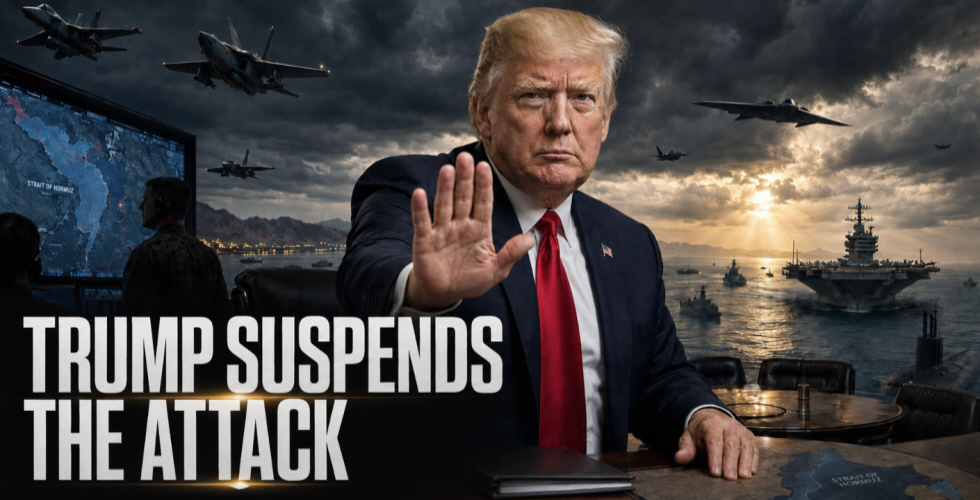
United States President Donald Trump decided to temporarily suspend a large-scale military attack against Iran to provide diplomacy with another opportunity. The operation would have targeted strategic Iranian sites and was reportedly ready to be executed. Trump claimed that its magnitude would have significantly exceeded other recent offensives. The decision created an unexpected pause during one of the conflict’s most dangerous moments. The American president said the armed forces were prepared to carry out what he described as the largest attack since World War II.
However, that comparison represents Trump’s own characterization and has not been confirmed by an independent military assessment. The offensive could have included energy facilities, defensive positions, and Iranian maritime capabilities. Its immediate suspension temporarily reduced the possibility of a broader regional escalation. Trump explained that several allied countries and international mediators requested additional time to pursue a negotiated solution. Gulf nations fear that another offensive could provoke retaliation against cities, military bases, and oil facilities.
Saudi Arabia, Qatar, and the United Arab Emirates have expressed concern about a wider confrontation. Regional stability now depends on whether this diplomatic opportunity produces concrete progress. The president announced that talks intended to reduce hostilities would begin on Monday afternoon. Nevertheless, Washington has not revealed where they would take place, who would participate, or how long they might continue. It also remains unclear whether the contacts would be direct or conducted through representatives of mediating countries.
This lack of detail raises numerous questions about the initiative’s actual scope. Iran, for its part, denied that it is currently participating in direct negotiations with the United States. The government in Tehran maintained that its discussions are exclusively with Oman and focused on commercial navigation. This contradiction demonstrates the considerable distance between the accounts presented by the two governments. It also suggests that a political agreement remains far from guaranteed. Iranian authorities are seeking to establish a temporary and secure shipping route through the Strait of Hormuz in cooperation with Oman. Such a corridor could partially restore the transportation of oil, gas, and other goods disrupted by the fighting. Tehran insists on preserving its influence over maritime traffic near its territory.
Washington, meanwhile, is demanding permanent guarantees for international freedom of navigation. The Strait of Hormuz remains the strategic center of this crisis because of its importance to global energy supplies. A significant portion of the oil and gas traded internationally passes through this narrow waterway every day. Attacks against vessels and restrictions on navigation have increased transportation costs. Every new military threat also produces considerable volatility across international markets. Trump’s announcement caused oil prices to decline and temporarily improved investor sentiment.
Markets interpreted the suspension as a signal that Washington might prioritize negotiations over another military offensive. However, that reaction could change rapidly if diplomatic contacts fail. American and Iranian forces continue to maintain their capabilities in readiness for a possible collapse of the pause. The suspension does not yet represent a permanent ceasefire or the conclusion of the confrontation. The United States retains the option of restarting its operations if it believes Iran has rejected the proposed conditions.
Tehran has also warned that it will retaliate against American and regional interests following any new aggression. The military threat therefore continues to serve as an instrument of pressure surrounding the diplomatic process. The coming hours will be decisive in determining whether Trump’s pause creates a genuine path toward stability. An agreement concerning the Strait of Hormuz could become the first step toward addressing broader political and nuclear disputes.
Nevertheless, the absence of Iranian confirmation requires caution regarding the optimism expressed by Washington. For now, the attack remains suspended while the region awaits tangible results from diplomacy.