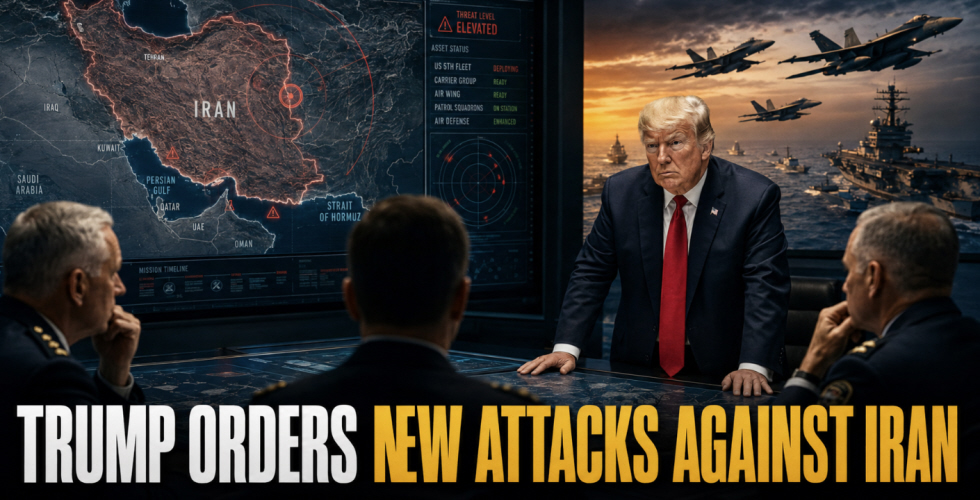
President Donald Trump ordered the United States military to prepare a new offensive against Iran that could begin during the weekend. The decision represents another dangerous turn in a conflict that continues spreading across different parts of the Middle East. Washington seeks to increase pressure on Tehran following unsuccessful negotiations and recent attacks against American targets. Authorities have not yet publicly confirmed that the new bombing campaign has begun. The military plans reportedly contemplate a major operation intended to weaken the Islamic Republic’s strategic and defensive capabilities.
The United States could concentrate its attacks on military installations, launch centers and positions connected to Iranian forces. There is also concern that the offensive could reach energy infrastructure used to finance Tehran’s military operations. The Pentagon is keeping its movements under strict secrecy while deploying additional resources to the region. Trump declared that the United States would respond with overwhelming force if Iran continued attacking American positions and allied countries. The president believes diplomatic discussions have not produced sufficient results to stop Iranian military actions.
During his latest remarks, he promised to strike Iran harder until the country loses its ability to continue fighting. His statements immediately increased political, military and economic uncertainty throughout the Persian Gulf. The new order follows several incidents involving American forces and commercial vessels navigating regional waters. Washington accuses Tehran and its allied organizations of conducting a campaign intended to challenge the Western presence. Iran rejects some of those accusations and maintains that its operations are legitimate responses to foreign military pressure.
The escalating exchange of threats is pushing both countries closer to a confrontation with unpredictable consequences. The Strait of Hormuz remains one of the principal sources of tension because it is essential for the transportation of global oil and gas supplies. Trump is demanding that Iran allow safe navigation and abandon any attempt to control or disrupt maritime traffic. Attacks against commercial vessels have raised insurance costs and increased concern among international shipping companies.
A new American offensive could trigger Iranian retaliation against ships, ports and energy facilities across the region. Tehran warned that it would respond forcefully if the United States attacked its refineries, power plants or other essential infrastructure. Iranian authorities also indicated that countries facilitating American operations could become targets of retaliation. Those threats are generating concern in Kuwait, Saudi Arabia, Jordan and other nations maintaining military cooperation with Washington.
Regional governments are strengthening their defenses while attempting to prevent an even broader war. American forces have fighter jets, bombers, warships and missile defense systems deployed at strategic positions throughout the region. The objective is to maintain sufficient capacity to launch an offensive and respond rapidly to any Iranian counterattack. United States bases remain on maximum alert because of the threat posed by missiles, drones and Tehran-aligned organizations. Washington is also coordinating its decisions with Israel and other military partners operating in the Middle East.
The possible offensive could directly affect international markets and cause another considerable increase in global energy prices. Any prolonged disruption in the Strait of Hormuz would reduce supplies available to Asia, Europe and other major consuming regions. Investors are monitoring military movements amid fears that a limited operation could develop into a prolonged regional war. The economic impact could also raise transportation, industrial production and food costs across numerous countries.
Questions are growing inside the United States regarding the ultimate objectives of the Trump administration’s strategy. Some political groups support a forceful response to protect American troops and guarantee international freedom of navigation. Others warn that additional bombing could deepen the conflict without forcing the Iranian government to surrender. The debate also includes concerns about political authorization and the human consequences of another major military campaign.
The international community is attempting to preserve diplomatic channels as the possible execution of Trump’s order approaches. Several nations fear that a large-scale offensive would eliminate any immediate opportunity to reach a negotiated agreement. Iran insists that it will not surrender to threats and promises to defend its territory against any foreign incursion. The world is watching a decision that could determine the direction of the Middle East for months to come.