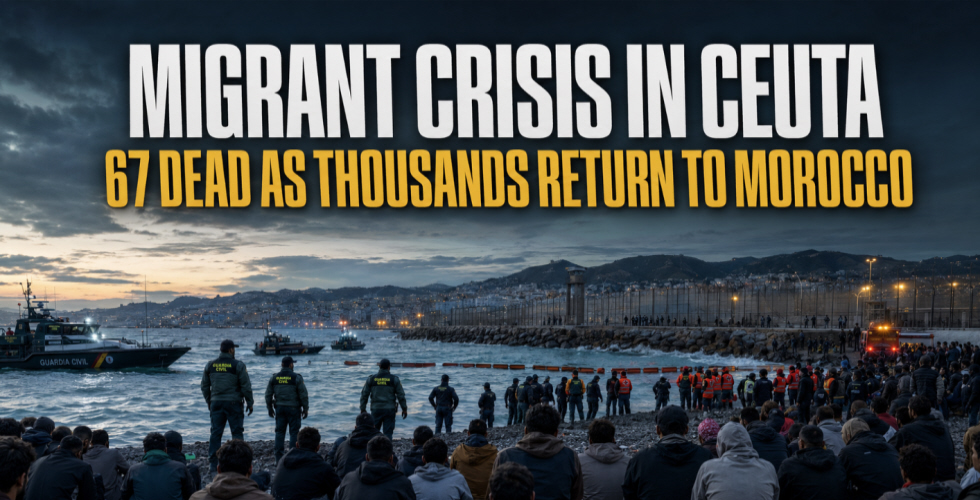
Ceuta is gradually returning to calm after an unprecedented arrival of migrants from Moroccan territory. Between 50,000 and 60,000 people reportedly crossed the border during the most critical hours of the emergency. The scale of the movement overwhelmed available resources and profoundly disrupted daily life across the city. Spanish authorities deployed police and military units to control the situation and protect the border. The official death toll rose to 67 after additional bodies were recovered along the coastal area. Some migrants drowned while attempting to reach Ceuta by swimming around the Tarajal breakwater.
Others lost their lives during stampedes caused by desperation and the massive concentration of people. Emergency teams continue their operations because additional victims could still be found at sea. Most of those who managed to enter Ceuta have already returned to Morocco in recent days. More than 48,000 migrants reportedly went back after finding themselves without food, shelter or opportunities to continue their journey. Some returned voluntarily, while others were escorted toward the border by Spanish authorities. Spain says the crisis was contained rapidly with the cooperation of the Moroccan government.
The border remains under heavy surveillance to prevent migrants from attempting the dangerous crossing again. Authorities also seek to stop their movement from Ceuta toward mainland Spain and other European countries. Police officers, civil guards and military personnel continue patrolling the principal access points into Spanish territory. No additional mass crossings were reported overnight, and the situation remained relatively stable. Spain began installing a floating barrier approximately 500 meters long along the maritime border with Morocco. The structure is intended to discourage irregular crossings around the breakwater where numerous deaths and accidents occurred. A controlled passage will allow vessels operated by the Civil Guard to continue patrolling the surrounding waters.
The measure provides an immediate response while the government considers permanent mechanisms for reinforcing border security. The Spanish government attributes the massive movement to networks involved in trafficking and exploiting vulnerable people. Authorities believe misleading information encouraged thousands of migrants to travel simultaneously toward the border with Ceuta. Many began the journey believing they would subsequently be allowed to reach mainland Spain and other European nations. However, Ceuta maintains special controls preventing automatic travel into other European territories.
The emergency also opened an intense political debate in Spain over the management of its external borders. Opposition parties questioned the government’s ability to anticipate and contain a movement of such extraordinary magnitude. The administration defended its response and maintained that territorial control was restored within approximately 24 hours. Political accusations are increasing as authorities investigate how such a large and coordinated crossing became possible. The crisis also generated serious concern among European Union governments because of its potential regional consequences.
Several countries requested an emergency meeting to discuss collective measures and provide greater operational support to Spain. Officials are also considering a stronger Frontex presence along the Spanish borders located in North Africa. The episode once again demonstrates Europe’s deep divisions over migration, security and humanitarian responsibility. Social organizations and volunteers warned about the difficult conditions experienced by those who remained temporarily in Ceuta.
The lack of shelter, food and adequate assistance increased the vulnerability of families, young people and unaccompanied minors. The high number of deaths made this emergency one of Spain’s deadliest border incidents. The victims reflect the enormous dangers faced by people using maritime routes or improvised crossings to migrate. Although most migrants have returned to Morocco, the pressure surrounding Ceuta has not completely disappeared.
Spain will maintain reinforced surveillance while reassessing border cooperation with Morocco and requesting support from Europe. The challenge will be protecting territorial integrity without abandoning humanitarian obligations toward people facing immediate danger. The tragedy leaves 67 lives lost and another warning about the urgent need for coordinated migration solutions.