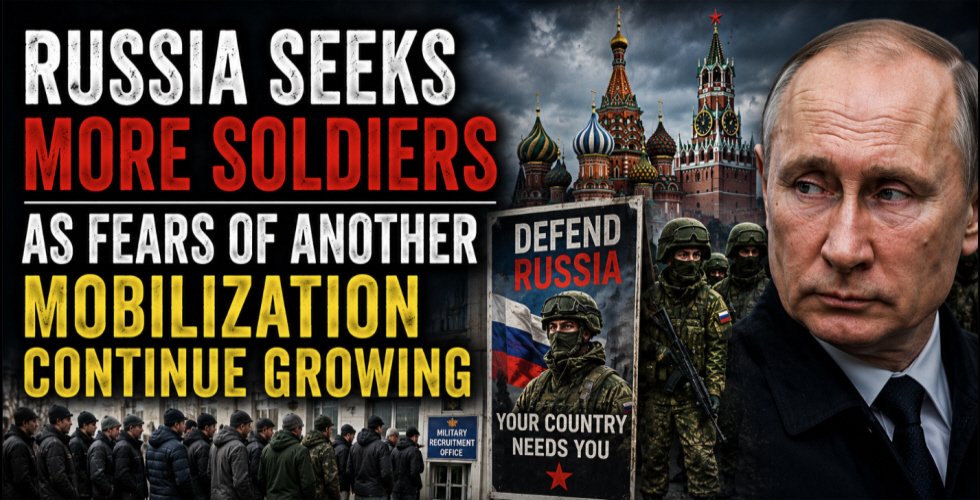
Russia is facing increasing pressure to maintain the number of soldiers needed to continue its military operations in Ukraine. After more than four years of war, accumulated losses and declining voluntary recruitment are forcing authorities to find new ways to bring men into the armed forces. Moscow continues to avoid announcing another mass mobilization like the one carried out in 2022. However, fears are once again growing inside the country that such a decision could eventually become necessary. Recent reports describe increasingly aggressive recruitment methods in different Russian regions, including men being detained in public places and pressured to sign military contracts.
Families and witnesses have reported cases in which some men were taken directly to recruitment centers after being approached on the streets. In certain cases, relatives say they learned what had happened only after family members had disappeared for several hours. Stories of children saying their fathers were taken by recruiters are increasing anxiety among the population. The Kremlin is attempting to maintain its voluntary contract system through substantial financial incentives that can represent several years of income for residents of Russia’s poorer regions.
Regional authorities are offering extraordinary payments, high salaries and additional compensation to persuade new recruits to join the military. For years, this system allowed Moscow to obtain soldiers without ordering another nationwide mobilization. But the number of volunteers appears increasingly unable to compensate easily for losses suffered on the battlefield. Western estimates currently place Russian casualties at extremely high levels, although Moscow does not publish comprehensive figures that would allow those calculations to be independently confirmed.
Some assessments suggest tens of thousands of Russian soldiers are being killed or wounded every month as offensive operations continue across different areas of the front. This situation forces the military to constantly bring in new personnel simply to replace its losses. Maintaining sufficient reserves for future operations therefore represents an additional challenge for Russian commanders. Regional authorities are also facing growing pressure to meet recruitment targets established for 2026. Governors, local administrations and military offices are participating in campaigns designed to find candidates willing to sign contracts with the armed forces.
Their strategies include advertising, substantial financial rewards and even payments to people who successfully persuade others to enlist. Military recruitment has consequently become a massive operation extending across virtually every region of the country. Among the groups reportedly facing greater recruitment pressure are people with debts, citizens experiencing financial difficulties, former prisoners and men involved in various legal problems. There are also reports of students and younger Russians receiving financial offers to join specialized military units, including operations involving drones.
For many potential recruits, the amounts being offered are difficult to ignore because of significant income differences between Moscow and poorer regions. Money therefore remains one of the Kremlin’s most important tools for keeping recruitment functioning. Vladimir Putin understands the political cost that another nationwide mobilization could carry. When approximately 300,000 reservists were called up in September 2022, thousands of Russians left the country while protests erupted and long lines appeared at several border crossings.
Since then, the government has tried to avoid repeating a measure capable of producing a similar public reaction. Moscow is therefore continuing to rely on contracts, financial incentives and regional recruitment campaigns before considering another large-scale call-up. Despite official denials that another mobilization is imminent, rumors have again begun circulating widely among the Russian population. Expanding recruitment campaigns, efforts to strengthen military registration systems and reports of higher regional targets are fueling speculation.
Ukrainian officials have also warned about the possibility that Russia could broaden recruitment after parliamentary elections scheduled for September. Moscow rejects such claims and maintains that there is currently no need to order another general mobilization. The Kremlin’s challenge is to maintain enough military personnel without provoking an internal reaction capable of affecting political stability. Every new soldier sent to the battlefield allows operations to continue, but constant casualties require Russia to keep its recruitment machinery permanently active.
At the same time, reports have emerged of growing numbers of soldiers accused of abandoning their units or refusing to continue fighting. The longer the war continues, the greater the human cost Russia must absorb to maintain its military objectives. As the conflict continues, the question of how long Russia can sustain its current recruitment model is becoming increasingly important.
The Kremlin still has a large population and sufficient financial resources to offer significant incentives, meaning that claims Russia is simply running out of soldiers would be an oversimplification. Nevertheless, growing difficulties in attracting volunteers indicate that replacing battlefield losses is becoming more expensive and complicated. Between financial incentives, regional pressure and fears of another mobilization, finding enough soldiers has become one of Vladimir Putin’s most significant domestic challenges.