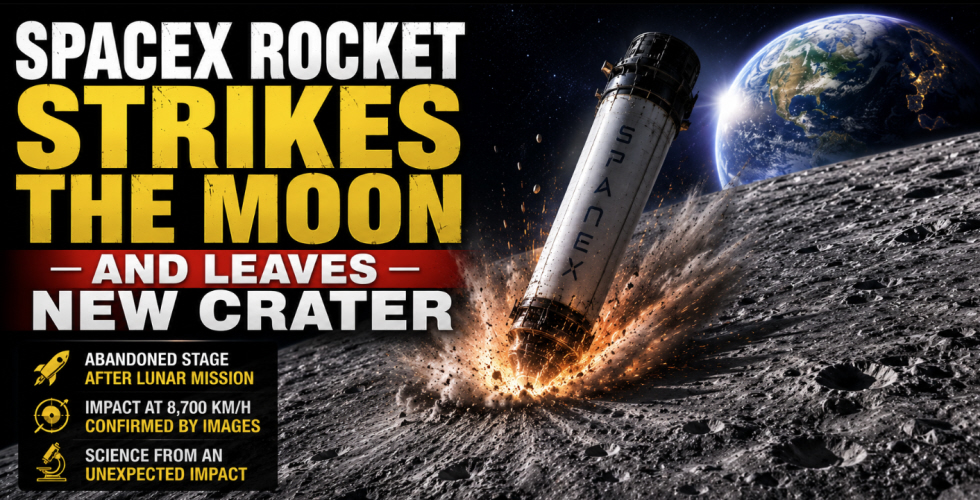
An abandoned upper stage from a SpaceX Falcon 9 rocket has struck the surface of the Moon after spending more than a year following an unstable trajectory through space. The object was launched in January 2025 to carry two private missions toward the Moon and was left without sufficient fuel to perform a controlled disposal maneuver. The gravitational forces of Earth, the Moon and the Sun progressively altered its trajectory until the collision became inevitable. The impact occurred on August 5, 2026, and was subsequently confirmed through observations from lunar orbit.
The upper stage was traveling at approximately 8,700 kilometers per hour when it reached the surface near the Einstein crater region, close to the boundary between the Moon’s near and far sides. The object had a mass of several thousand kilograms, meaning the energy released during the collision was sufficient to throw lunar dust and fragments of regolith into the surrounding area. Unlike an object entering Earth’s atmosphere, the rocket encountered no air capable of significantly reducing its velocity before reaching the ground. Virtually all that energy was therefore transferred directly into the lunar surface.
The clearest confirmation came from South Korea’s Danuri lunar orbiter, which photographed the location before and after the collision. The images revealed an evident alteration of the terrain and the appearance of a new crater where no such formation had previously existed. Danuri conducted observations of the region that provided scientists with an unusual opportunity to directly compare the changes produced by the impact. An accidental space collision was consequently transformed into an unexpected scientific experiment on the Moon.
The event is particularly interesting because researchers know the characteristics of the object responsible for the new crater with considerable precision. Its origin, approximate dimensions, mass, velocity and trajectory had been studied before the collision, allowing scientists to predict some of the effects it might produce. Researchers can now compare those estimates with the actual dimensions of the crater and the distribution of material ejected during the impact. That information can improve models used to understand how craters form on planetary bodies without significant atmospheres.
Observations from Earth also provided information about the moments surrounding the collision. Astronomical instruments monitored the expected impact while different research teams attempted to study the material released above the lunar surface. Combining ground-based and orbital observations may allow scientists to reconstruct an event that occurred within only a few moments. Every additional measurement can improve our understanding of how artificial objects interact with the regolith covering much of the Moon.
The collision posed no danger to Earth and was not directed toward any lunar installation, but it raises important questions about the increasing number of artificial objects traveling through the space between our planet and the Moon. New commercial and government missions are sending growing numbers of probes, landers, satellites and rocket stages into this region. Some objects can remain abandoned after completing their missions and continue traveling for years along complicated trajectories. Tracking this space debris will become increasingly important as human activity around the Moon expands.
The issue will become even more significant when permanent or semi-permanent installations begin operating on the lunar surface. A rocket stage that can currently fall into an uninhabited region could present a very different risk once bases, scientific instruments, energy systems and vehicles are operating regularly. Understanding the trajectories of abandoned objects will make it possible to anticipate potential impacts and develop procedures for safely disposing of them. Lunar exploration will therefore need to incorporate space-debris management as activity around the Moon increases.
High-energy missions toward the Moon present different challenges from conventional launches in which rocket stages can sometimes conduct controlled maneuvers after completing their primary tasks. When nearly all available propellant is required to send a payload toward a distant destination, very little capability may remain to alter the rocket stage’s later trajectory. The challenge for future missions will be to consider what happens to every major component after it completes its primary function. Sustainable space exploration begins by reducing the number of uncontrolled objects left behind.
The new crater also demonstrates how an accidental event can generate valuable scientific information when researchers have sufficient capability to observe it. Scientists now have an impact for which the approximate time, responsible object and collision velocity are known, something that rarely occurs when a natural meteoroid strikes the Moon. Comparing those measurements with the visible consequences can improve understanding of impact physics and the behavior of lunar soil.
The knowledge obtained could eventually help researchers better assess the risks that small asteroids and other objects might present to future human installations. The Falcon 9 upper stage ended its journey in a way that was never part of the mission’s original objective, but its impact left more than a new crater on the Moon.
The episode provides information about planetary science, orbital dynamics and the behavior of lunar regolith while highlighting a new generation of challenges associated with humanity’s expansion into deep space. As more missions travel toward the Moon, controlling what happens to spacecraft after their operations end will become increasingly important. Future exploration will depend not only on our ability to travel farther, but also on learning to responsibly manage everything we leave behind.