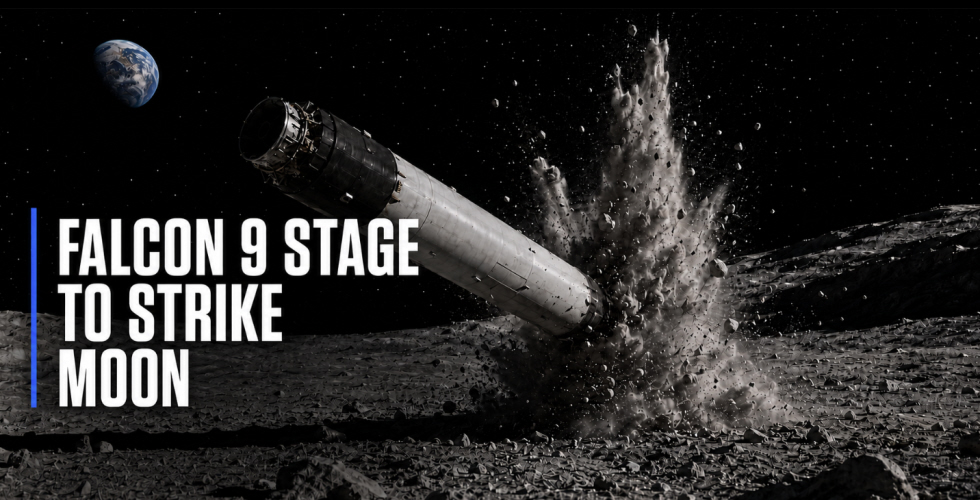
A spent upper stage from a SpaceX Falcon 9 rocket will accidentally strike the surface of the Moon on Wednesday, August 5. The object has been drifting without control for more than a year after completing its primary mission. Orbital calculations indicate that there is no longer any possibility of preventing the collision. The event will provide scientists with an extraordinary opportunity to study a previously predicted lunar impact. The rocket stage was launched from Florida’s Kennedy Space Center on January 15, 2025. Its mission was to carry the Blue Ghost and Resilience lunar landers toward the Moon.
After releasing the spacecraft, the upper stage remained trapped in a complex trajectory between Earth and its natural satellite. Gravitational forces slowly altered its path until it was directed toward the lunar surface. The object has an estimated mass of nearly four metric tons and no remaining fuel to change its direction. Unlike satellites that remain in controlled Earth orbits, this large metallic structure was left traveling through deep space. Specialists tracked its movement for months through observations collected from different locations around the world.
Those measurements allowed scientists to calculate the expected time and probable location of the impact with remarkable precision. The collision will occur near Einstein Crater on the Moon’s illuminated western limb. The stage will be traveling at approximately 8,700 kilometers per hour when it reaches the lunar surface. That speed will produce energy comparable to the explosion of several tons of conventional explosives. The impact will be powerful enough to permanently alter a small region of the Moon. Calculations suggest that the collision could create a crater approximately 27 meters wide.
The excavation may also reach a depth of nearly five meters in the lunar soil. A large amount of dust, rock and metallic debris will be thrown above the surface. Some of this material could rise dozens of kilometers before gradually falling back to the Moon. The initial flash will probably be too faint to observe with the naked eye from Earth. However, powerful telescopes may detect the dust cloud produced during the first few minutes. The best viewing conditions are expected in parts of the United States, Canada and South America. Professional and amateur astronomers are preparing their equipment to follow this unusual and scientifically valuable event.
Several orbiting spacecraft will also participate in observing the impact and its consequences. NASA’s Lunar Reconnaissance Orbiter will examine the region before and after the collision. South Korea’s Danuri spacecraft could provide complementary images and measurements from lunar orbit. Comparing the collected data will help determine the crater’s actual size and the distribution of the ejected material. The collision also represents a warning about the growing problem of abandoned debris between Earth and the Moon. Increasing numbers of commercial, scientific and government missions are filling this region with structures that are difficult to control.
These objects could eventually threaten satellites, landers, research stations and future inhabited bases. Expanding lunar activity will require more effective international systems for tracking and disposing of space debris. The Falcon 9 upper stage does not represent any danger to Earth or its population. It was also not intentionally directed toward the Moon as part of a planned scientific experiment. The collision will result from a trajectory that could not be corrected after the mission was completed.
The case demonstrates the need to design responsible disposal systems for every component used during a space launch. The impact will transform a space-debris problem into an unexpected opportunity to expand scientific knowledge.
Researchers will be able to compare their models with the crater’s real dimensions and the behavior of the lunar dust cloud. The observations will also support the development of stronger protection measures for future human operations on the Moon. The event will remain a warning that space exploration must advance without abandoning environmental responsibility.