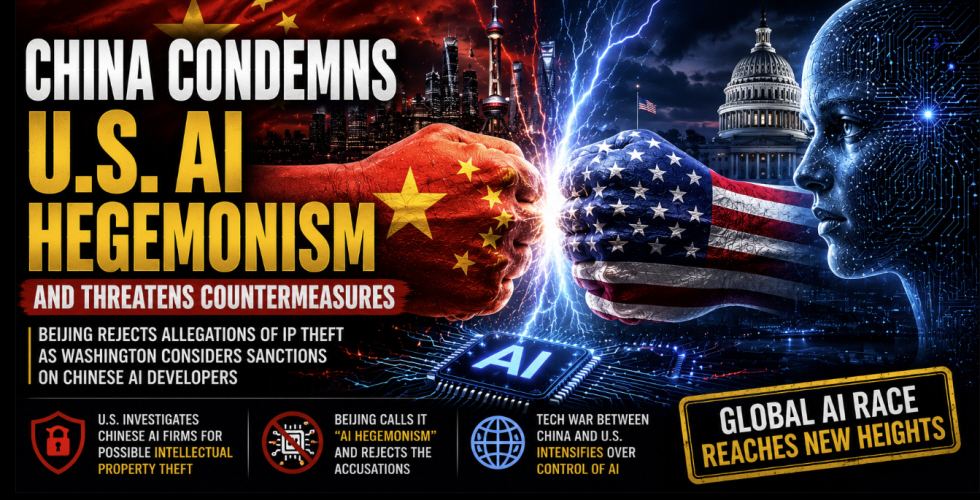
The growing competition between China and the United States over leadership in artificial intelligence intensified once again after Beijing strongly criticized potential U.S. sanctions targeting Chinese AI developers. Chinese officials described the proposed measures as an attempt to suppress fair competition through political and economic pressure. The dispute highlights the strategic importance that artificial intelligence now holds on the global stage. China's Ministry of Commerce argued that any effort to restrict the development of its technology companies represents an unfair attempt to hinder international innovation.
Officials emphasized that technological progress should be driven by cooperation, open competition, and mutual respect rather than unilateral restrictions. Beijing reaffirmed its commitment to supporting the continued growth of its AI industry. The statements followed reports that U.S. authorities are considering additional actions involving Chinese companies developing advanced artificial intelligence systems. Washington has expressed concerns related to national security, technological competitiveness, and the possible misuse of intellectual property. Those concerns remain part of a broader strategic rivalry between the world's two largest economies.
Chinese authorities rejected the allegations, insisting that the accusations lack credible evidence and unfairly target domestic technology firms. Officials maintained that Chinese companies operate within the law and that innovation should be evaluated through objective standards rather than geopolitical considerations. Beijing dismissed the claims as politically motivated. China also warned that it is prepared to implement countermeasures if new sanctions are ultimately imposed by the United States. Although no specific actions were announced, government representatives made it clear that they intend to protect the legitimate interests of Chinese technology companies.
The warning immediately drew the attention of international markets and industry observers. Artificial intelligence has rapidly become one of the most important areas of economic and strategic competition between Washington and Beijing. Both nations continue investing billions of dollars in advanced research, semiconductor development, computing infrastructure, and next-generation AI applications. The race for technological leadership continues to accelerate. Analysts believe that decisions made by either country could have significant consequences for global businesses, investors, and research institutions.
International technology supply chains increasingly depend on cooperation among multiple markets, making any escalation in tensions capable of affecting innovation worldwide. The outcome could reshape future technological partnerships. Beyond trade and investment, the dispute also involves issues related to cybersecurity, data protection, digital sovereignty, and geopolitical influence. Artificial intelligence is no longer viewed simply as an emerging technology but as a strategic resource capable of strengthening national power and global competitiveness.
This explains why tensions continue to intensify. As diplomatic disagreements persist, technology companies around the world are closely monitoring developments that could affect investment strategies, international partnerships, and long-term innovation projects. The uncertainty has encouraged many organizations to prepare for different regulatory and commercial scenarios. Businesses are adapting to an increasingly complex global environment.
The latest confrontation between Washington and Beijing demonstrates that artificial intelligence has become one of the defining strategic competitions of the twenty-first century. Beyond accusations and possible sanctions, the greatest challenge will be finding ways to encourage technological innovation while preventing deeper divisions between the world's leading economic powers.